
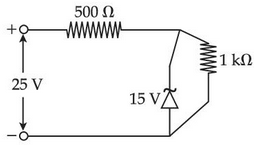
A Zener diode is used in a voltage regulator circuit as shown below. Its breakdown voltage is 15 V. What is the current flowing through the zener diode?
Answer & explanation
Correct answer: option 1
The correct answer is Option (1) → 5 mA
In reverse breakdown the Zener diode keeps the voltage across it fixed at its breakdown voltage, 15 V. The 1 kΩ load is in parallel with the diode, so it also has 15 V across it. The rest of the input voltage drops across the 500 Ω series resistor, which carries the total current.
\( \displaystyle V_{500} = 25 - 15 = 10\,\mathrm{V} \)
\( \displaystyle I = \frac{10\,\mathrm{V}}{500\,\Omega} = 0.02\,\mathrm{A} = 20\,\mathrm{mA} \)
\( \displaystyle I_L = \frac{15\,\mathrm{V}}{1000\,\Omega} = 0.015\,\mathrm{A} = 15\,\mathrm{mA} \)
By Kirchhoff's junction rule, the total current divides between the load and the diode:
\( \displaystyle I_Z = I - I_L = 20 - 15 = 5\,\mathrm{mA} \)