
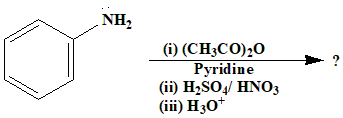
The major product of the following reaction will be
Answer & explanation
Correct answer: option 3
The correct answer is Option (3) → p-nitroaniline
Direct nitration of aniline is not used: the –\( \ce{NH2} \) group is oxidised by \( \ce{HNO3} \), and in acid much of the aniline is protonated to the meta-directing anilinium ion. The amino group is therefore protected by acetylation, which also reduces its activating effect so that the nitro group enters the para position; hydrolysis then frees the amino group:
\( \displaystyle \ce{C6H5NH2 + (CH3CO)2O} \xrightarrow{\text{pyridine}} \ce{C6H5NHCOCH3 + CH3COOH} \)
\( \displaystyle \ce{C6H5NHCOCH3 + HNO3} \xrightarrow{\ce{H2SO4}} \text{p-}\ce{O2N-C6H4-NHCOCH3 + H2O} \)
\( \displaystyle \text{p-}\ce{O2N-C6H4-NHCOCH3 + H2O} \xrightarrow{\ce{H3O+}} \text{p-}\ce{O2N-C6H4-NH2 + CH3COOH} \)
Why the other options are incorrect
Option (1) m-nitroaniline — Incorrect. The meta product is formed in large amount only when aniline itself is nitrated in acid (through the anilinium ion); the acetamido group directs ortho/para.
Option (2) o-nitroaniline — Incorrect. The bulky –\( \ce{NHCOCH3} \) group hinders the ortho positions, so the para isomer is the major product.
Option (4) 2,6-dinitroaniline — Incorrect. Acetylation lowers the activating effect of the group, so only one nitro group enters, and that at the para position.
NCERT (2026-27 edition):
Electrophilic Substitution – “… (b) Nitration: Direct nitration of aniline yields tarry oxidation products in addition to the nitro derivatives. Moreover, in the strongly acidic medium, aniline is protonated to form the anilinium ion which is meta directing. That is why besides the ortho and para derivatives, significant amount of meta derivative is also formed. … However, by protecting the –NH2 group by acetylation reaction with acetic anhydride, the nitration reaction can be controlled and the p-nitro derivative can be obtained as the major product.”