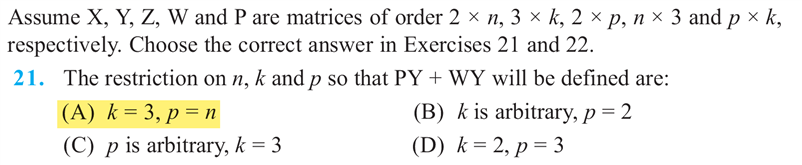
If X, Y, Z, W and P are matrices of order 2 × n, 3 × k, 2 × p, n × 3 and p × k respectively, the restrictions on n, k and p so that PY + WY is defined are:
Answer & explanation
Correct answer: option 1
The correct answer is Option (1) → k = 3, p = n
A product UV is defined only when the number of columns of U equals the number of rows of V; two matrices can be added only when they have the same order.
PY: P is p × k and Y is 3 × k. The columns of P (k) must equal the rows of Y (3):
\(k = 3\), and then PY is of order p × k
WY: W is n × 3 and Y is 3 × k. The columns of W (3) equal the rows of Y (3), so WY is always defined:
WY is of order n × k
PY + WY: the orders p × k and n × k must be the same:
\(p = n\)
So the restrictions are k = 3 and p = n.
NCERT (2026-27 edition):
Operations on Matrices