
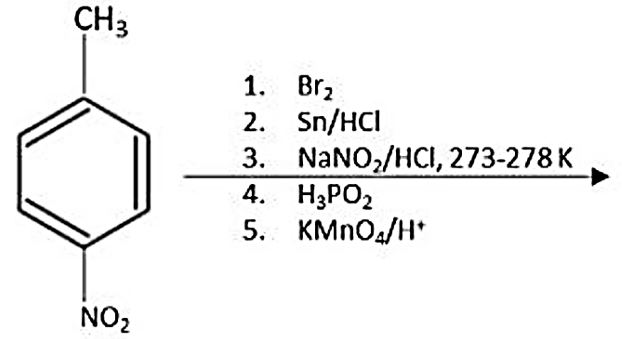
In the following reaction, the product A is
Answer & explanation
Correct answer: option 3
The correct answer is Option (3) → o-Bromobenzoic acid
In this sequence the nitro group is used only to steer the bromine into place; it is then turned into a diazonium group and removed. Each reagent does one step, in the order given.
First, bromination (electrophilic substitution, with \( \ce{FeBr3} \) as the usual Lewis acid catalyst). The –\( \ce{CH3} \) group is an activating ortho/para director and –\( \ce{NO2} \) a deactivating meta director. The para position of –\( \ce{CH3} \) is occupied by –\( \ce{NO2} \), and the position ortho to –\( \ce{CH3} \) is also meta to –\( \ce{NO2} \), so both groups direct bromine to the same carbon, next to the methyl group:
\( \displaystyle \text{4-nitrotoluene} + \ce{Br2} \xrightarrow{\ce{FeBr3}} \text{2-bromo-4-nitrotoluene} + \ce{HBr} \)
With Sn/HCl, the nitro group is reduced to an amino group:
\( \displaystyle \ce{Ar-NO2 + 6[H]} \xrightarrow{\ce{Sn}/\ce{HCl}} \ce{Ar-NH2 + 2H2O} \quad \text{(3-bromo-4-methylaniline)} \)
With \( \ce{NaNO2} \)/HCl at 273-278 K, the aromatic amine is diazotised:
\( \displaystyle \ce{Ar-NH2 + NaNO2 + 2HCl} \xrightarrow{273-278\ \mathrm{K}} \ce{Ar-N2+Cl^- + NaCl + 2H2O} \)
Hypophosphorous acid reduces the diazonium salt and puts a hydrogen atom in place of the diazonium group, which leaves as nitrogen. The product is 2-bromotoluene:
\( \displaystyle \ce{Ar-N2+Cl^- + H3PO2 + H2O -> Ar-H + N2 + H3PO3 + HCl} \)
Finally, acidified \( \ce{KMnO4} \) oxidises the side-chain methyl group to a carboxyl group, whatever its length; the C–Br bond of the ring is not affected:
\( \displaystyle o\text{-}\ce{Br-C6H4-CH3} \xrightarrow{\ce{KMnO4}/\ce{H+}} o\text{-}\ce{Br-C6H4-COOH} \)
The bromine stays next to the carbon that carried the methyl group, so A is o-bromobenzoic acid (2-bromobenzoic acid).