
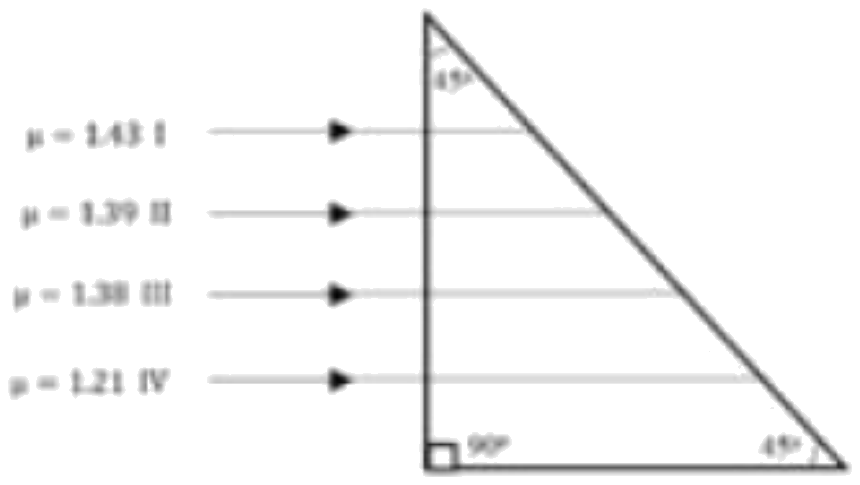
There are four light rays incident on a right angled prism in a direction as shown in the figure. The refractive index of prism material for the rays are 1.43, 1.39, 1.38, 1.21 respectively. The ray that suffers total internal reflection is
Answer & explanation
Correct answer: option 1
The correct answer is Option (1) → I
The rays enter the vertical face normally and go straight on to the slanting face. Since the prism angles are \( 45^\circ \), every ray meets the slanting face at an angle of incidence of \( 45^\circ \). Total internal reflection happens if this angle exceeds the critical angle \( C \), where \( \sin C = 1/\mu \).
\( \displaystyle i \gt C \;\Rightarrow\; \sin 45^\circ \gt \frac{1}{\mu} \;\Rightarrow\; \mu \gt \frac{1}{\sin 45^\circ} = \sqrt{2} = 1.414 \)
\( \text{I: } 1.43 \gt 1.414 \ \Rightarrow \text{ total internal reflection} \)
\( \text{II, III, IV: } 1.39,\ 1.38,\ 1.21 \lt 1.414 \ \Rightarrow \text{ these rays refract out} \)
So only ray I is totally internally reflected.
Note: This question is from NCERT (2026-27). NTA sets numerical questions from NCERT too, so do not ignore NCERT while practising numericals.
NCERT (2026-27):
Total Internal Reflection in Nature and Its Technological Applications – “… Prisms designed to bend light by 90° or by 180° make use of total internal reflection [Fig. 9.13(a) and (b)]. Such a prism is also used to invert images without changing their size [Fig. 9.13(c)]. In the first two cases, the critical angle ic for the material of the prism must be less than 45°.”