
Case: Read the passage and answer the question.
Consider a coil C1 connected to a galvanometer G as shown. A bar magnet is placed near the coil with its North pole facing the coil and its South pole away from it. The magnet is then moved towards the coil.
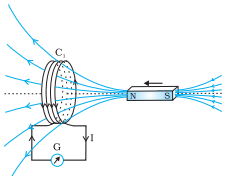
Answer the following question in this context.
Event 1: The South pole is moved towards the coil.
Event 2: The North pole is moved away from the coil.
Both motions are at the same speed. Which of the following is correct?
Answer & explanation
Correct answer: option 4
The correct answer is Option (4) → The current developed is in the same direction in both events.
By Lenz’s law, the induced current flows in a direction that opposes the change in magnetic flux producing it. So the face of the coil nearer the magnet behaves as a pole that opposes the motion of the magnet.
Option (1) The currents developed are in directions opposite to each other. — Incorrect. In both events the near face of the coil becomes a South pole, so the current circulates the same way round the coil.
Option (2) A smaller emf is developed in Event 2. — Incorrect. The emf depends on how fast the flux through the coil changes. The same magnet moves at the same speed in both events. So the flux changes at the same rate, and the emf in Event 2 is not smaller.
Option (3) No current is developed in Event 2. — Incorrect. A magnet moving away from the coil also changes the flux through it, so a current is induced and the galvanometer deflects.
Option (4) The current developed is in the same direction in both events. — Correct. The near face of the coil takes the same polarity in both events:
Event 1: to oppose the approaching South pole, the near face becomes a South pole and repels it.
Event 2: to oppose the receding North pole, the near face becomes a South pole and attracts it back.
The same polarity of the near face means the same direction of current in the coil.
NCERT (2026-27):
The Experiments of Faraday and Henry – “… When the North-pole of a bar magnet is pushed towards the coil, the pointer in the galvanometer deflects, indicating the presence of electric current in the coil. … When the magnet is pulled away from the coil, the galvanometer shows deflection in the opposite direction, which indicates reversal of the current’s direction. Moreover, when the South-pole of the bar magnet is moved towards or away from the coil, the deflections in the galvanometer are opposite to that observed with the North-pole for similar movements.”