CUETMOCK
  • Pricing
  • Mentors
Log inStart freeStart free mocks→

First test, then trust

Try a free CUET mock test.

Join 5,00,000+ students who rehearsed exam day on the exact NTA screen before sitting CUET. On the web and on Android.

Start free mocks →Get the Android app
CUETMOCK

India's #1 CUET Mock Test Platform. Original NCERT-based questions on the exact NTA exam screen — trusted by 5,00,000+ students since CUET 2022.

Get it onGoogle PlayScan to download the CUETMOCK app

Mock tests

  • CUET mock test series
  • Browse all papers
  • Commerce mocks
  • Humanities (Arts) mocks
  • Science mocks
  • Languages & GAT mocks
  • Free practice questions
  • Pricing

Resources

  • CUET exam guide
  • CUET syllabus
  • Universities accepting CUET
  • Expert blogs
  • News & notifications
  • Webinars & counselling
  • CUET score calculator
  • How we estimate your rank
  • FAQs

Company

  • About us
  • Our leadership & team
  • Our toppers
  • Mentors
  • For schools
  • Contact us
  • Terms
  • Privacy
  • Refund policy

Talk to us

+91 7696 6630 56info@cuetmock.comWhatsApp us

Our other platforms

  • JEE Mock — For IIT-JEE aspirants
  • NEET Mock — For NEET aspirants

Newsletter

Exam updates, study material and offers — no spam.

© 2026 NYC Ventures Pvt. Ltd.

701-702, Royal Business Park, Zirakpur, Punjab - 140603

  • Terms of use
  • Privacy policy
  • Refund policy
  • Contact us

iCUETMOCK is an independent preparation platform, not affiliated with the National Testing Agency (NTA). Always check exam details on the official NTA website.

  • Home
  • Mock tests
  • CUET guide
  • Pricing
  • Log in
Home/Practice questions/Economics
EconomicsMicro Economics: Theory of Firms under Perfect Competition

Which of the following condition must be satisfied for profit maximiz…

Which of the following condition must be satisfied for profit maximization under perfect competition for the Short Run (SR) and for the Long Run (LR) respectively?

Where P = Price, AVC = Average variable cost, AFC = Average fixed cost, AC = Average cost.

Answer & explanation+

Correct answer: option 4

The correct answer is Option (4) → In the Short Run P ≥ AVC & In the Long Run P ≥ AC

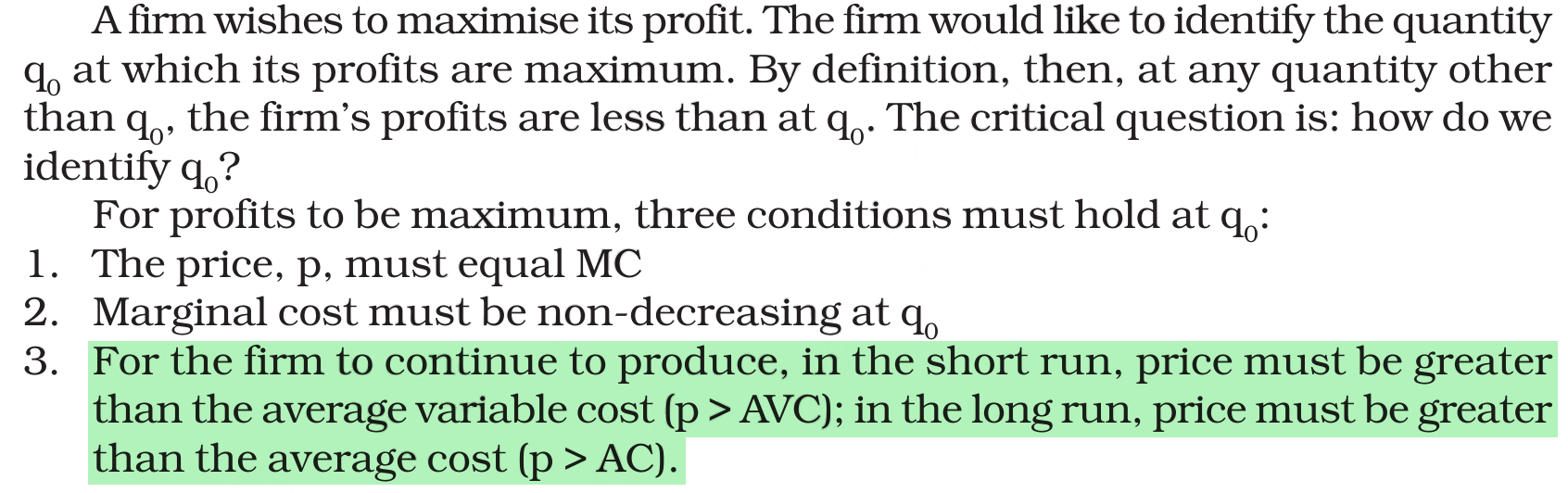
A firm under perfect competition takes the price as given and only chooses how much to produce. Its profit maximisation needs three conditions: price equals marginal cost, marginal cost is non-decreasing at that output, and the price is high enough for the firm to continue to produce. The question is about the third condition, and it depends on which costs the firm can still avoid by shutting down:

  • In the short run the fixed cost is already committed and has to be paid even if nothing is produced, so only the variable cost matters. The price must cover average variable cost: P ≥ AVC.

  • In the long run nothing is fixed. The firm can give up its plant and premises, so every cost is avoidable, and the price must cover average cost: P ≥ AC.

Both conditions come from one idea: a cost that cannot be escaped should not decide whether to produce.

Why the other options are incorrect

  • Option (1) In the Short Run P ≥ AC & In the Long Run P ≥ AVC — Incorrect. The two conditions are the wrong way round: the short run needs only AVC covered, the long run all of AC.

  • Option (2) In the Short Run P ≥ AVC & In the Long Run P ≥ AFC — Incorrect. The short-run part is right, but average fixed cost is the fixed cost per unit, and there is no fixed cost in the long run.

  • Option (3) In the Short Run P ≥ AC & In the Long Run P ≥ AFC — Incorrect. Both parts are wrong: the short run needs only AVC covered, and the long run has no fixed cost.


NCERT: Introductory Microeconomics — Chapter 4: The Theory of the Firm under Perfect Competition (2025-26)

NCERT extract

Advertisement

Practise more on Micro Economics: Theory of Firms under Perfect Competition

Chapter-wise mocks on the real NTA exam screen, with solutions and your rank. Your first mocks are free.

Start free mocks →

Advertisement

Next questions

  1. Match the LIST-I with LIST-II.LIST-IUnitsLIST-IIOrder of reactionA. s−1I. ZeroB. mol L−1 s−1II. FirstC. mol−1 L s−1III. ThirdD. mol−2 L2 s−…Chemistry · Physical: Chemical Kinetics
  2. Match the LIST-I with LIST-II:LIST-ITerms/PositionsLIST-IIMeaningsA. ShroffI. PeasantB. MandalII. Money-changerC. PatwariIII. Panchayat-hea…History · Medieval India: Peasants, Zamindars and the State
  3. Match the LIST-I with LIST-IILIST-IGeographical PhenomenaLIST-IIMetaphors used as Symbols from Human AnatomyA.IsthmusI.ProfileB.GlacierII.E…Geography · Fundamentals of Human Geography: Human Geography-Nature and Scope
  4. Arrange the following in chronological order, starting from the oldest to the latest.A. India and Pakistan became independent nationsB. Ind…Economics · Indian Economic Development: Comparative Development Experiences of India and its Neighbours
  5. Human Development Index (HDI) values range between ___________ .Geography · Fundamentals of Human Geography: Human Development
  6. Choose the most appropriate option to complete the following:The solar-powered greenhouse factories on Mars would replicate the process of…English · Comprehension - (Narrative / Factual)
  7. The source of electromagnetic waves can bePhysics · Electromagnetic Waves
  8. Match List-I with List-IIList-IList-IIElectromagnetic WavesProduction(A) Ultraviolet rays(I) Radioactive decay of the nucleus.(B) Infrared…Physics · Electromagnetic Waves
  9. Which one of the following statements is incorrect regarding amino acids?Chemistry · Organic: Biomolecules
  10. A metallic sphere of radius 6 cm is melted and recast into a cone of radius 4 cm. Find the height of the cone.General Aptitude Test · Quantitative Reasoning