Match the LIST-I with LIST-II:
| LIST-I Terms/Positions | LIST-II Meanings | ||
| A. | Shroff | I. | Peasant |
| B. | Mandal | II. | Money-changer |
| C. | Patwari | III. | Panchayat-headman |
| D. | Raiyat | IV. | Accountant |
Choose the correct answer from the options given below:
Answer & explanation
Correct answer: option 1
The correct answer is Option (1) → A - II, B - III, C - IV, D - I
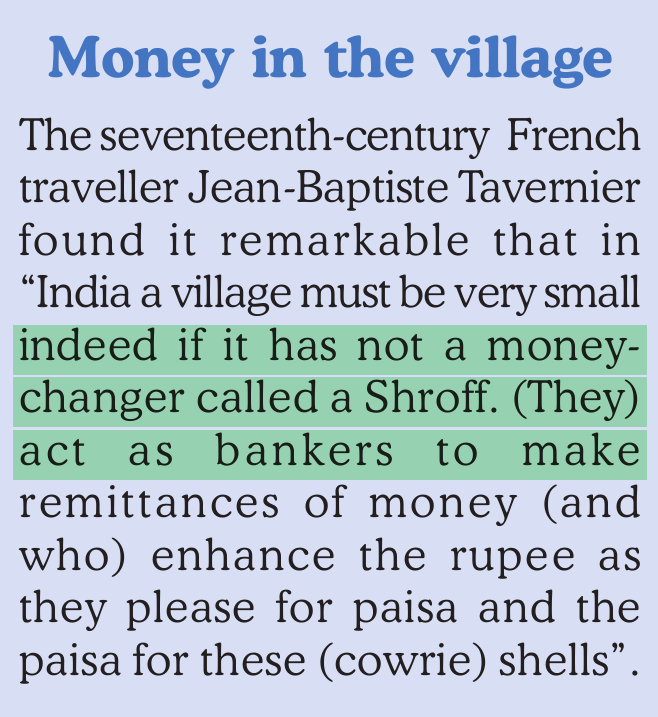
(A) Shroff — this matches (II) Money-changer. The French traveller Tavernier found that almost every Indian village had a moneychanger called a shroff, who acted as a banker and exchanged rupees for paisa and paisa for cowrie shells.
(B) Mandal — this matches (III) Panchayat-headman. The village panchayat was headed by a headman known as muqaddam or mandal, chosen by the village elders.
(C) Patwari — this matches (IV) Accountant. The headman supervised the village accounts with the help of the accountant or patwari of the panchayat.
(D) Raiyat — this matches (I) Peasant. Raiyat (plural riaya) was the term that Indo-Persian sources of the Mughal period most often used for a peasant.
NCERT (2025-26): “1.2 Peasants and their lands … The term which Indo-Persian sources of the Mughal period most frequently used to denote a peasant was raiyat (plural, riaya) or muzarian. In addition, we also encounter the terms kisan or asami.… 2.2 Panchayats and headmen … The panchayat was headed by a headman known as muqaddam or mandal. Some sources suggest that the headman was chosen through the consensus of the village elders, and that this choice had to be ratified by the zamindar. Headmen held office as long as they enjoyed the confidence of the village elders, failing which they could be dismissed by them. The chief function of the headman was to supervise the preparation of village accounts, assisted by the accountant or patwari of the panchayat.…”
|