Match the LIST-I with LIST-II
| LIST-I | LIST-II | ||
|---|---|---|---|
| A. | Capital Redemption Reserve | I. | Shareholders\' Funds |
| B. | Deferred Tax Liabilities | II. | Current Assets |
| C. | Cash and Cash Equivalents | III. | Reserve and Surplus |
| D. | Money Received against Share Warrants | IV. | Non-Current Liabilities |
Choose the correct answer from the options given below:
Answer & explanation
Correct answer: option 4
The correct answer is Option (4) → A - III, B - IV, C - II, D - I
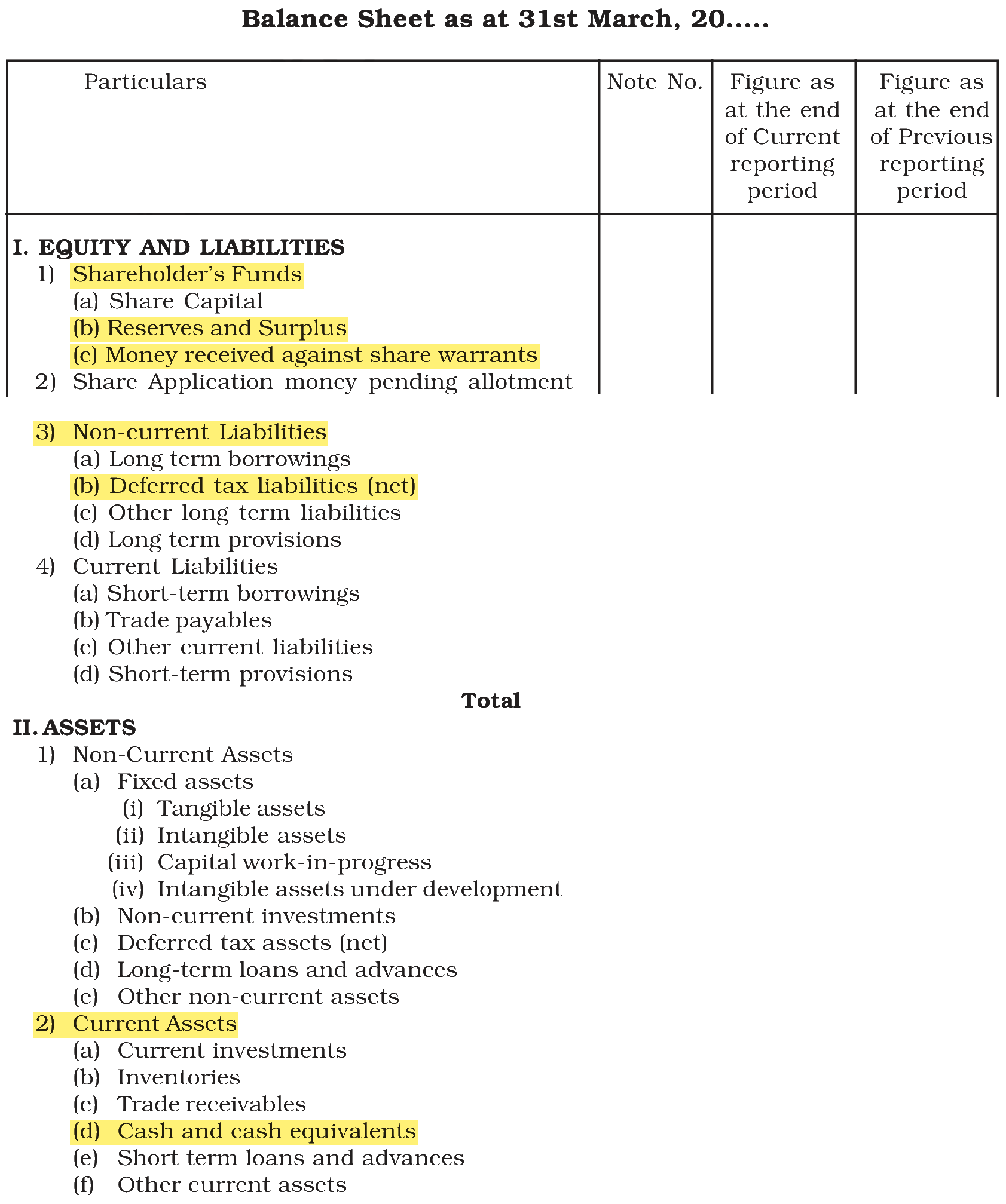
Schedule III fixes the head and sub-head under which every item of the balance sheet is shown.
(A) Capital Redemption Reserve — this matches (III) Reserve and Surplus. It is a reserve created out of profits on redemption of preference shares or buy-back, so it is listed among the items of Reserves and Surplus.
(B) Deferred Tax Liabilities — this matches (IV) Non-Current Liabilities. The tax is payable in later years, not within twelve months, and it is sub-head (b) under Non-current Liabilities.
(C) Cash and Cash Equivalents — this matches (II) Current Assets, where it is sub-head (d).
(D) Money Received against Share Warrants — this matches (I) Shareholders’ Funds. A warrant holder has paid for the right to take shares later, so the money belongs with the owners’ funds, as sub-head (c) after Share Capital and Reserves and Surplus.
NCERT (2026-27 edition):
NCERT (2026-27 edition): |