Cyclohexanecarbaldehyde reacts with zinc-amalgam in the presence of concentrated hydrochloric acid to give the compound X. The compound X is
Answer & explanation
Correct answer: option 4
The correct answer is Option (4) → methylcyclohexane
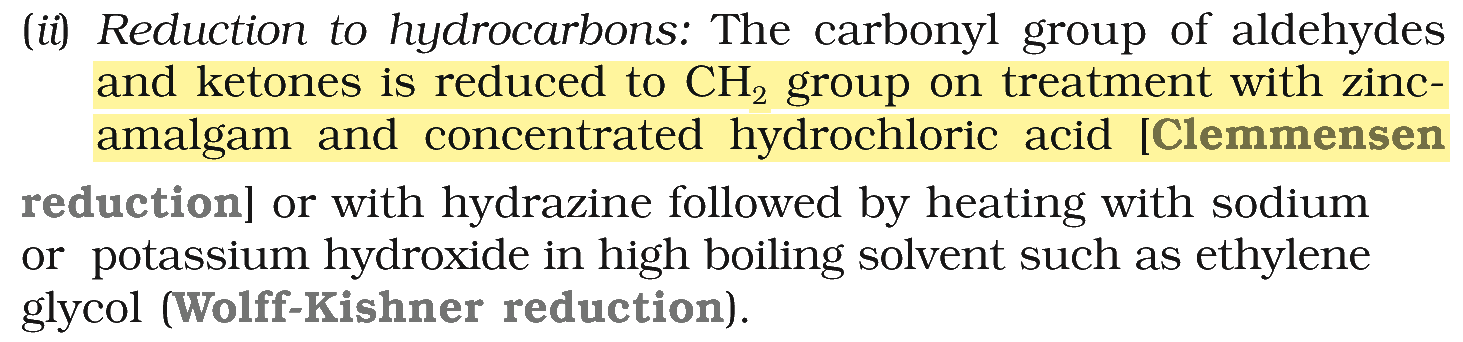
In the Clemmensen reduction, the carbonyl group of an aldehyde or ketone is reduced to a CH2 group by zinc amalgam and concentrated hydrochloric acid. No carbon atom is added or lost:
\( \displaystyle \ce{R2C=O + 4[H]} \xrightarrow{\ce{Zn-Hg}/\text{conc. }\ce{HCl}} \ce{R2CH2 + H2O} \)
Its look-alike, the Wolff-Kishner reduction, does the same job in base: the hydrazone of the carbonyl compound is heated with KOH in ethylene glycol. It is used for compounds that are not stable to acid.
\( \displaystyle \ce{R2C=O + NH2NH2 -> R2C=NNH2 + H2O} \)
\( \displaystyle \ce{R2C=NNH2} \xrightarrow[\text{ethylene glycol, heat}]{\ce{KOH}} \ce{R2CH2 + N2} \)
Cyclohexanecarbaldehyde is \( \ce{C6H11-CHO} \). Its –CHO group becomes –\( \ce{CH3} \):
\( \displaystyle \ce{C6H11-CHO + 4[H]} \xrightarrow{\ce{Zn-Hg}/\text{conc. }\ce{HCl}} \ce{C6H11-CH3 + H2O} \)
So X is methylcyclohexane.
Why the other options are incorrect
Option (1) isopropylcyclohexane — Incorrect. It has two carbon atoms more than the aldehyde; the reduction adds no carbon.
Option (2) cyclohexanecarbaldehyde — Incorrect. This is the starting aldehyde itself; its C=O group has not been reduced.
Option (3) ethylcyclohexane — Incorrect. It has one carbon atom more than the aldehyde.
NCERT (2026-27 edition):
Reduction to Hydrocarbons