
Which one of the following represents the correct feasible region determined by the following constraints \(x - y \ge 5, 5x - 5y \le 16\)
Answer & explanation
Correct answer: option 1
The correct answer is Option (1) →
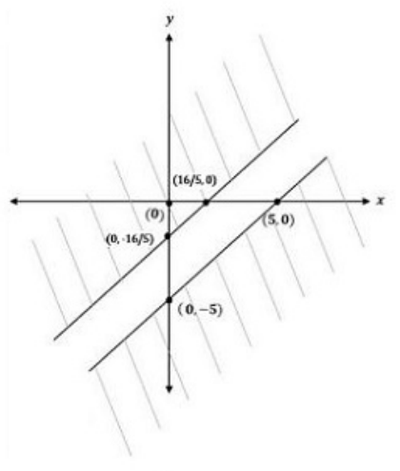
Each inequality is a half-plane. Its boundary line is drawn through the two intercepts, and the origin test shows which side is shaded.
For \(x - y \ge 5\), the boundary line \(x - y = 5\) passes through (5, 0) and (0, −5). At the origin:
\(0 - 0 = 0 \lt 5\)
The origin does not satisfy it, so this half-plane lies below and to the right of the line.
Dividing the second constraint by 5:
\( \displaystyle x - y \le \frac{16}{5} \)
Its boundary line passes through (16/5, 0) and (0, −16/5). At the origin, \(0 \le \frac{16}{5}\) is true, so this half-plane contains the origin and lies above and to the left of the line.
Both lines have slope 1, so they are parallel. A point in both half-planes would need
\( \displaystyle 5 \le x - y \le \frac{16}{5} \)
which is impossible, because \(\frac{16}{5} = 3.2 \lt 5\). The two shaded half-planes do not overlap, so there is no feasible region. Option (1) shades each half-plane on its correct side and shows no common part.
Why the other options are incorrect
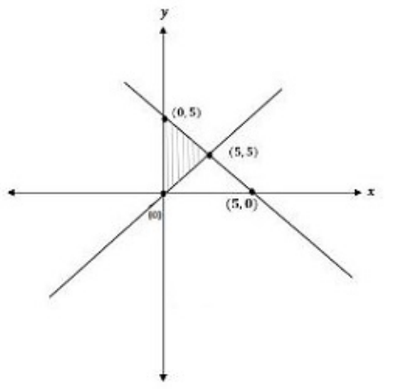
Option (2) — Incorrect. Its lines pass through (0, 5), (5, 0) and the origin, so they are not the lines \(x - y = 5\) and \(x - y = \frac{16}{5}\).
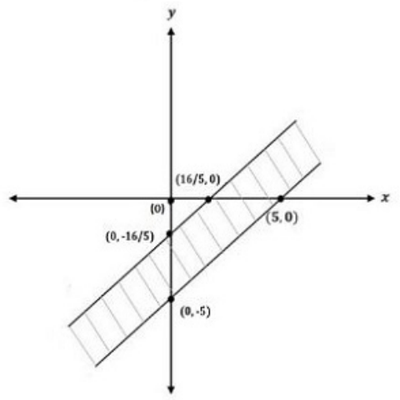
Option (3) — Incorrect. It shades the strip between the two lines, which is \(\frac{16}{5} \le x - y \le 5\). Both inequalities are reversed.
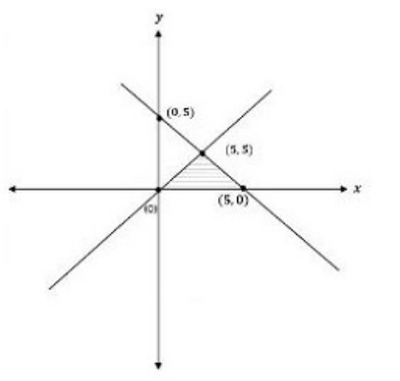
Option (4) — Incorrect. Like Option (2), it uses lines through (0, 5), (5, 0) and the origin, not the given boundary lines.
Note: The question asks for “the correct feasible region”, but these two constraints have no common solution, so the feasible region is empty. Option (1) is the only figure that shows both constraints correctly, and it shows that there is no common region.