__________ is chiral (optically active) compound.
Answer & explanation
Correct answer: option 1
The correct answer is Option (1) → cis-[CrCl2(ox)2]3–
A molecule or ion is chiral (optically active) when it is not superimposable on its mirror image. This happens when it has no plane of symmetry. In coordination compounds, optical isomerism is common in octahedral complexes with bidentate (chelating) ligands, such as oxalate (ox) or ethane-1,2-diamine (en).
In [CrCl2(ox)2]3−, chromium is +3 and has two chloride ligands and two oxalate chelate rings:
cis isomer: the two \( \ce{Cl^{-}} \) ligands are next to each other (90°), and the two oxalate rings are arranged like the blades of a propeller. There is no plane of symmetry, so the cis isomer exists as a pair of enantiomers (d and l) and is optically active.
trans isomer: the two \( \ce{Cl^{-}} \) ligands are opposite each other (180°), and both oxalate rings lie in one plane. That plane is a plane of symmetry, so the trans isomer is optically inactive.
So the chiral compound is cis-[CrCl2(ox)2]3−.
Why the other options are incorrect
Option (2) trans-[CrCl2(ox)2]3– — Incorrect. The plane containing the two oxalate rings is a plane of symmetry, so it is superimposable on its mirror image.
Option (3) K2[Zn(OH)4] — Incorrect. \( \ce{[Zn(OH)4]^{2-}} \) is tetrahedral with four identical ligands, which has several planes of symmetry.
Option (4) [Ni(CO)4] — Incorrect. Also tetrahedral with four identical ligands, so it is not chiral.
NCERT (2026-27 edition):
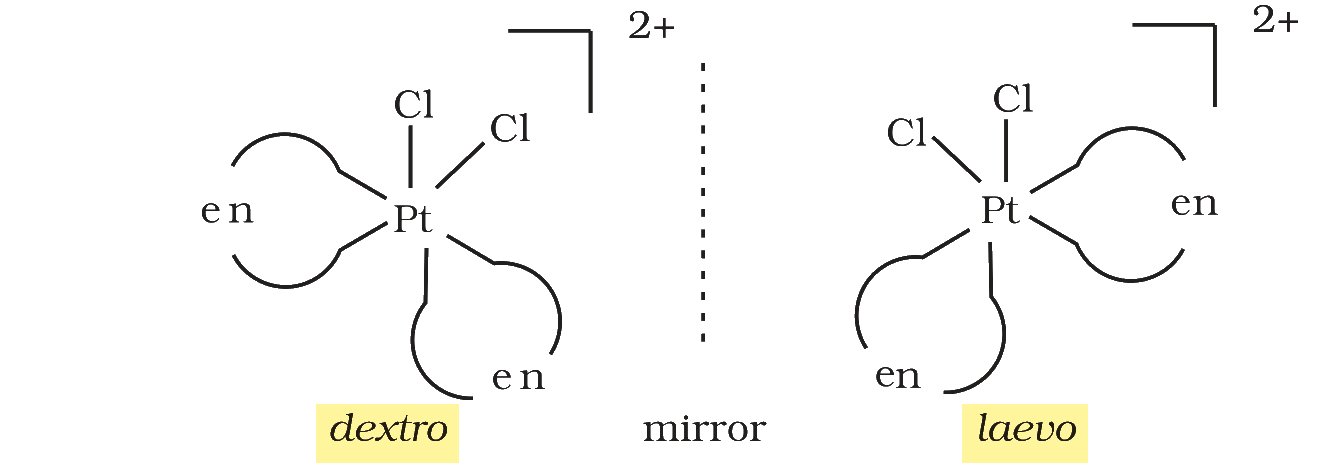
Optical Isomerism – “Optical isomers are mirror images that cannot be superimposed on one another. These are called as enantiomers. The molecules or ions that cannot be superimposed are called chiral. The two forms are called dextro (d) and laevo (l) depending upon the direction they rotate the plane of polarised light in a polarimeter (d rotates to the right, l to the left). Optical isomerism is common in octahedral complexes involving didentate ligands (Fig. 5.6). In a coordination entity of the type [PtCl2(en)2]2+, only the cis-isomer shows optical activity (Fig. 5.7).”