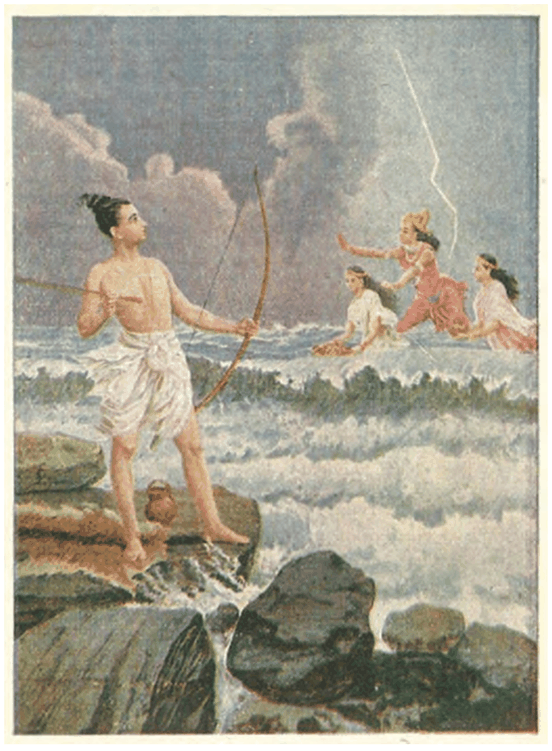
Raja Ravi Varma painted Puranic themes. Three of the following describe such paintings of his. Which one is the odd one out?
Answer & explanation
Correct answer: option 4
The correct answer is Option (4) → They externalise inner experiences of turbulence.
Option (1) They depict a historic moment or a scene from an epic. — A feature of these paintings. They are generally large and show such a moment from an epic or a classical text.
Option (2) They are painted in the midst of a dramatic action. — A feature of these paintings. The scene is caught at its most dramatic point.
Option (3) They are meant to be noble, momentous and emotional. — A feature of these paintings. This is the effect such paintings aim at.
Option (4) They externalise inner experiences of turbulence. — Not a feature of these paintings. This belongs to Gaganendranath Tagore’s City in the Night, where inner turbulence is shown through the syntax of Cubism.
NCERT (2026-27): “Rama Vanquishing the Pride of the Ocean This is a Puranic (ancient mythological stories) theme painted by Raja Ravi Varma. …These paintings are, generally, large ones, depicting a historic moment or scene from an epic or a classical text, painted in the midst of a dramatic action. It is intended to be noble, momentous and emotional.”
“City in the Night This is a watercolour painting made by Gaganendranath Tagore … in 1922. He was one of the earlier Indian painters, who made use of language and syntax of Cubism to render his ideas. The inner experiences of turbulence are externalised through a blend of allegorical and formal, transforming the static geometry of Analytical Cubism into an expressive apparatus.” |