Let \( f(x) \) be a function defined on an interval \( [a,b] \) such that \( f(x) \) is differentiable on \( (a,b) \). Then
Match the LIST-I with LIST-II
| LIST-I Where \( I \) is subset of \( [a,b] \) | LIST-II | ||
|---|---|---|---|
| (A) | function \( f(x) \) is increasing on interval \( I \) | (I) | \( f'(x)\lt 0\ \ \forall x\in I \) |
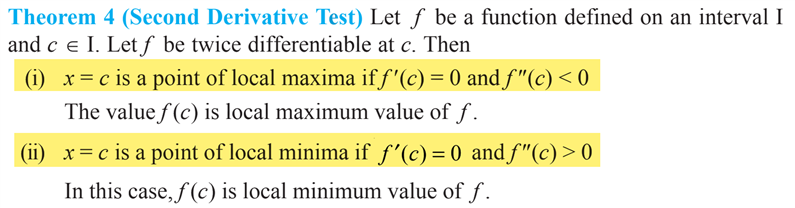
| (B) | function \( f(x) \) has local maxima at \( x=a \) | (II) | \( f'(a)=0\ \&\ f''(a)\gt 0 \) |
| (C) | function \( f(x) \) has local minima at \( x=a \) | (III) | \( f'(x)\gt 0\ \ \forall x\in I \) |
| (D) | function \( f(x) \) is decreasing on interval \( I \) | (IV) | \( f'(a)=0\ \&\ f''(a)\lt 0 \) |
Choose the correct answer from the options given below:
Answer & explanation
Correct answer: option 4
The correct answer is Option (4) → (A) - (III), (B) - (IV), (C) - (II), (D) - (I)
The list uses the first derivative test for monotonicity and the second derivative test for local extrema. In (B) and (C), x = a stands for a point of the interval at which f is twice differentiable.
(A) function f(x) is increasing on interval I
This matches (III) \( f'(x)\gt 0\ \forall x\in I \).
A positive derivative on an interval means f rises throughout it.
(B) function f(x) has local maxima at x = a
This matches (IV) \( f'(a)=0\ \&\ f''(a)\lt 0 \).
The tangent is horizontal and the curve is concave down, so the point is a peak.
(C) function f(x) has local minima at x = a
This matches (II) \( f'(a)=0\ \&\ f''(a)\gt 0 \).
The tangent is horizontal and the curve is concave up, so the point is a trough.
(D) function f(x) is decreasing on interval I
This matches (I) \( f'(x)\lt 0\ \forall x\in I \).
A negative derivative on an interval means f falls throughout it.
So the matching is (A)-(III), (B)-(IV), (C)-(II), (D)-(I).
Tip: Remember the direction: f″ < 0 gives a maximum and f″ > 0 gives a minimum. Swapping these is the trap in Option (3).
NCERT (2023-24 edition):
Application of Derivatives