CUETMOCK
  • Pricing
  • Mentors
Log inStart freeStart free mocks→

First test, then trust

Try a free CUET mock test.

Join 5,00,000+ students who rehearsed exam day on the exact NTA screen before sitting CUET. On the web and on Android.

Start free mocks →Get the Android app
CUETMOCK

India's #1 CUET Mock Test Platform. Original NCERT-based questions on the exact NTA exam screen — trusted by 5,00,000+ students since CUET 2022.

Get it onGoogle PlayScan to download the CUETMOCK app

Mock tests

  • CUET mock test series
  • Browse all papers
  • Commerce mocks
  • Humanities (Arts) mocks
  • Science mocks
  • Languages & GAT mocks
  • Free practice questions
  • Pricing

Resources

  • CUET exam guide
  • CUET syllabus
  • Universities accepting CUET
  • Expert blogs
  • News & notifications
  • Webinars & counselling
  • CUET score calculator
  • How we estimate your rank
  • FAQs

Company

  • About us
  • Our leadership & team
  • Our toppers
  • Mentors
  • For schools
  • Contact us
  • Terms
  • Privacy
  • Refund policy

Talk to us

+91 7696 6630 56info@cuetmock.comWhatsApp us

Our other platforms

  • JEE Mock — For IIT-JEE aspirants
  • NEET Mock — For NEET aspirants

Newsletter

Exam updates, study material and offers — no spam.

© 2026 NYC Ventures Pvt. Ltd.

701-702, Royal Business Park, Zirakpur, Punjab - 140603

  • Terms of use
  • Privacy policy
  • Refund policy
  • Contact us

iCUETMOCK is an independent preparation platform, not affiliated with the National Testing Agency (NTA). Always check exam details on the official NTA website.

  • Home
  • Mock tests
  • CUET guide
  • Pricing
  • Log in
Home/Practice questions/Sociology
SociologyIndian Society: Continuity and Change

In which year did Meghalaya Succession Act receive the President's as…

Read the passage and answer the following questions given:

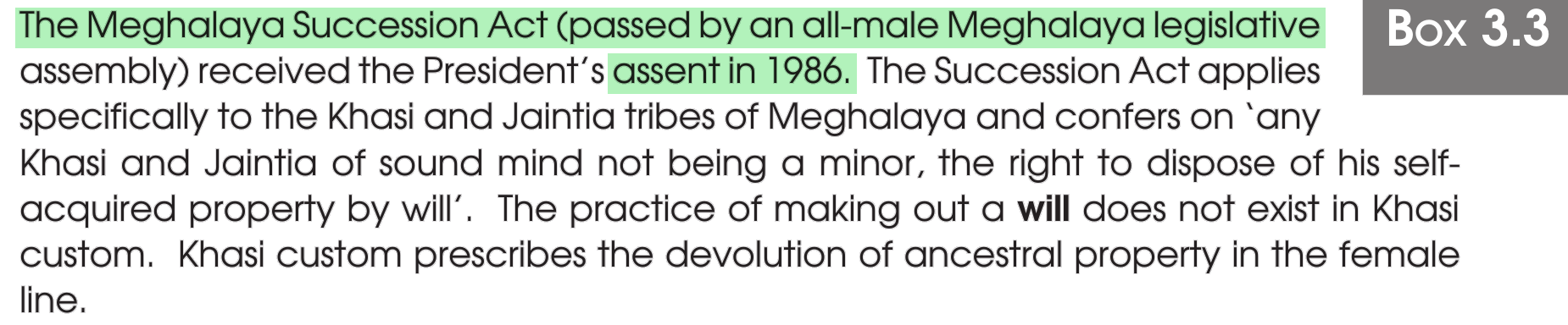
The Meghalaya Succession Act (passed by an all-male Meghalaya legislative assembly) received the President's assent in 1986. The Succession Act applies specifically to the Khasi and Jaintia tribes of Meghalaya and confers on 'any Khasi and Jaintia of sound mind not being a minor, the right to dispose of his self-acquired property by will'. The practice of making out a will does not exist in Khasi custom. Khasi custom prescribes the devolution of ancestral property in the female line.

There is a feeling, specially among the educated Khasi, that their rules of kinship and inheritance are biased in favour of women and are too restrictive. The Succession Act is therefore seen as an attempt at removing such restrictions and at correcting the perceived female bias in the Khasi tradition. To assess whether the popular perception of female bias in the Khasi tradition is indeed valid, it is necessary to view the Khasi matrilineal system in the context of the prevalent gender relations and definitions of gender roles.

Several scholars have highlighted the inherent contradictions in matrilineal systems. One such contradiction arises from the separation of the line of descent and inheritance on the one hand and the structure of authority and control on the other. The former, which links the mother to the daughter, comes in conflict with the latter, which links the mother's brother to the sister's son. (In other words, a woman inherits property from her mother and passes it on to her daughter, while a man controls his sister's property and passes on control to his sister's son. Thus, inheritance passes from mother to daughter whereas control passes from (maternal) uncle to nephew.

Khasi matriliny generates intense role conflict for men. They are torn between their responsibilities to their natal house on the one hand, and to their wife and children on the other. In a way, the strain generated by such role conflict affects Khasi women more intensely. A woman can never be fully assured that her husband does not find his sister's house a more congenial place than her own. Similarly a sister will be apprehensive about her brother's commitment to her welfare because the wife with whom he lives can always pull him away from his responsibilities to his natal house.

The women are more adversely affected than men by the role conflict generated in the Khasi matrilineal system not only because men wield power and women are deprived of it, but also because the system is more lenient to men when there is a transgression of rules. Women possess only token authority in Khasi society; it is men who are the defacto power holders. The system is indeed weighted in favour of male matri-kin rather than male patri-kin. (In other words, despite matriliny, men are the power holders in Khasi society; the only difference is that a man's relatives on his mother's side matter more than his relatives on his father's side.)

In which year did Meghalaya Succession Act receive the President's assent?

Answer & explanation+

Correct answer: option 4

The correct answer is Option (4) → 1986

Note: The Meghalaya Succession Act and its year appear in Box 3.3 of the pre-rationalised NCERT, which NTA followed in 2023; the box is no longer in the NCERT book (2025-26).


NCERT: Indian Society — Chapter 3: Social Institutions: Continuity and Change, Box 3.3 (Pre-rationalised)

NCERT extract

Advertisement

Practise more on Indian Society: Continuity and Change

Chapter-wise mocks on the real NTA exam screen, with solutions and your rank. Your first mocks are free.

Start free mocks →

Advertisement

Next questions

  1. Where will the adjustment of the retiring partner be done by the partnership firm for his share of the loss if the partner retires in the m…Accountancy Part A · Reconstitution of Partnership Firm: Retirement and Death
  2. The Pahari Schools of Painting grew in the hills of the western Himalayas. Given below are two statements about them:Statement I: The Pahar…Fine Arts · The Pahari Schools of Painting
  3. When did the Constitution of India come into effect?Political Science · Politics in India Since Independence: Era of one Party Dominance
  4. Change the following sentence into an Exclamatory sentence:It is strange that our neighbour’s cat has started sleeping in our shoe rack.English · Kinds of Sentence
  5. Natural selection in which more individuals acquire peripheral character values at both ends of the distribution curve is called:Biology · Evolution
  6. In equilateral ΔPQR, S and T are points on the PQ and PR, respectively, such that PS = RT. QT and RS intersect at O. The measure of ∠ROQ is…General Aptitude Test · Quantitative Reasoning
  7. When was slave trade abolished in Denmark ?Geography · Fundamentals of Human Geography: International Trade
  8. Identify the carbohydrate which is not a polysaccharideChemistry · Organic: Biomolecules
  9. In a 10 km race, A, B and C each run at uniform speed, get the first, second and third position respectively. If A beats B by 1 km and B be…Applied Maths. Section B2 · Numbers, Quantification and Numerical Applications
  10. Select the figure that will replace the question mark (?) in the following figure series.General Aptitude Test · Verbal Reasoning