
Natural selection in which more individuals acquire peripheral character values at both ends of the distribution curve is called:
Answer & explanation
Correct answer: option 3
The correct answer is Option (3) → Disruptive selection
Natural selection can act on a trait in three ways, and each way changes the shape of the distribution curve differently. When individuals with values at both ends of the curve are favoured, the population splits into two peaks.
Option (1) Stabilising selection — Incorrect. In stabilisation, more individuals acquire the mean character value, so the single peak becomes higher and narrower.
Option (2) Directional selection — Incorrect. In directional change, more individuals acquire a value other than the mean, so the peak shifts in one direction.
Option (3) Disruptive selection — Correct. In disruption, more individuals acquire peripheral character values at both ends of the distribution curve, and two peaks form.
Option (4) Artificial selection — Incorrect. Artificial selection is done by man when he breeds selected plants and animals. It is not one of the three patterns of natural selection.
NCERT Extract:
Hardy-Weinberg Principle – “… Coupled to enhance reproductive success, natural selection makes it look like different population. Natural selection can lead to stabilisation (in which more individuals acquire mean character value), directional change (more individuals acquire value other than the mean character value) or disruption (more individuals acquire peripheral character value at both ends of the distribution curve) (Figure 6.8).”
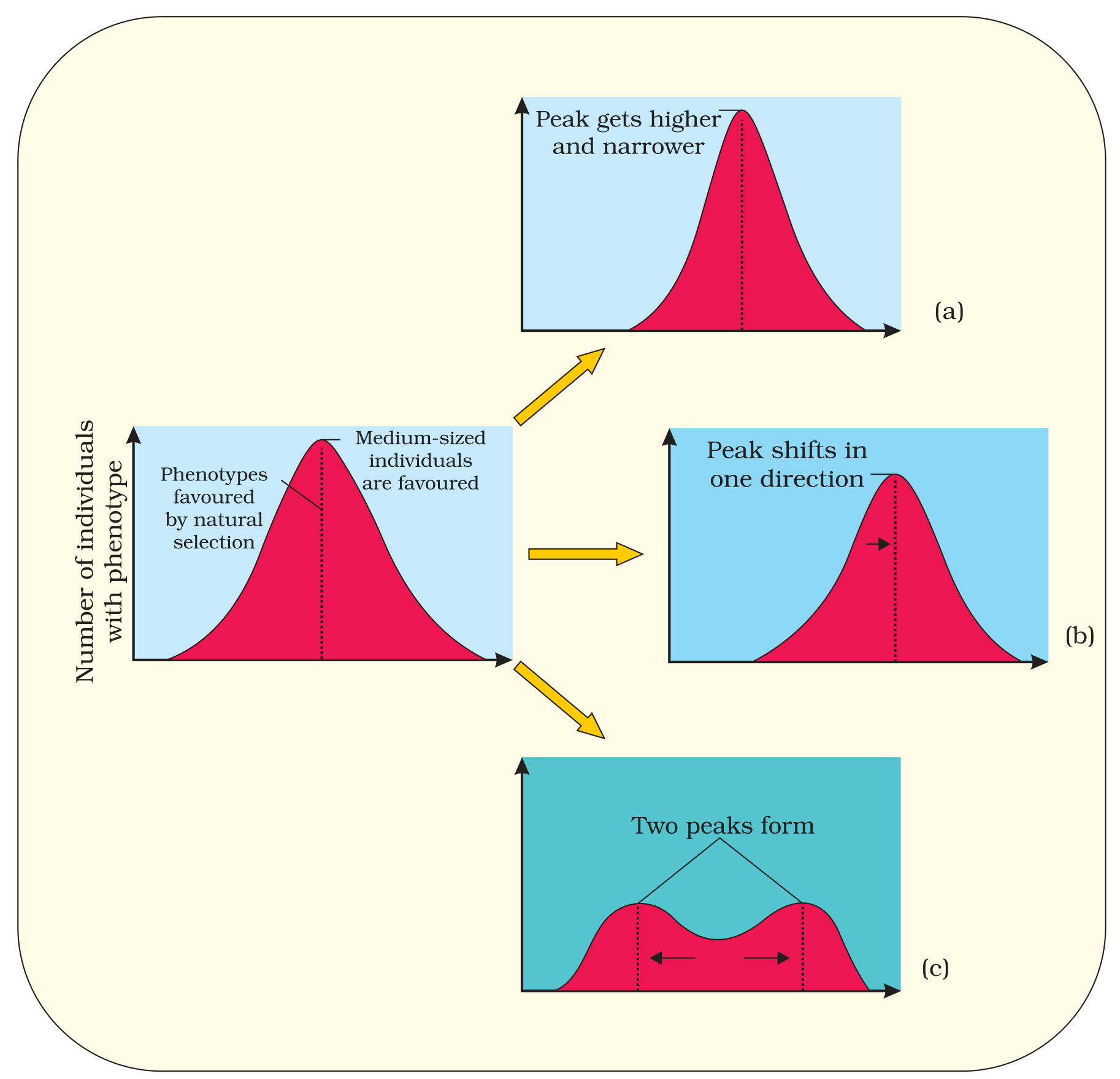
Figure 6.8 Diagrammatic representation of the operation of natural selection on different traits : (a) Stabilising (b) Directional and (c) Disruptive