In this question a few conclusions are drawn from two or more given statements. It is based on deductive reasoning rather than inductive reasoning. You have to consider the given statements to be true, even if they are different from established facts and accordingly choose the right answer.
Statements:
I) No square is a triangle
II) All triangles are circles
III) Some rectangles are squares
IV) Some circles are rectangles
Conclusions:
I) No square is a circle
II) All rectangles being triangles is a possibility
III) All circles being squares is a possibility
Answer & explanation
Correct answer: option 4
The correct answer is Option 4: None of the statements follow
Given Statements:
-
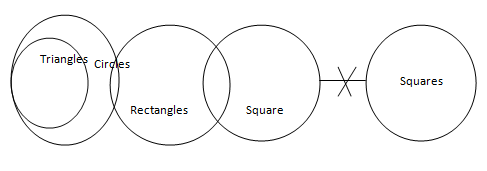
No square is a triangle: Squares and Triangles are entirely separate circles.
-
All triangles are circles: The Triangle circle is completely inside the Circle circle.
-
Some rectangles are squares: There is an overlap between Rectangles and Squares.
-
Some circles are rectangles: There is an overlap between Circles and Rectangles.
Evaluating the Conclusions:
Conclusion I: No square is a circle
-
While we know no square is a triangle, the Square circle could still overlap with the Circle circle (as long as it doesn't touch the triangle part). Since a connection is possible, we cannot definitively say "No square is a circle."
-
Result: Does not follow.
Conclusion II: All rectangles being triangles is a possibility
-
We know that "No square is a triangle." We also know that "Some rectangles are squares." This means there is a portion of Rectangles that are definitely Squares. Since those specific rectangles are squares, they cannot be triangles. Therefore, "All rectangles" can never be triangles.
-
Result: Does not follow.
Conclusion III: All circles being squares is a possibility
-
We know that "All triangles are circles." We also know "No square is a triangle." If all circles became squares, then the triangles (which are inside the circles) would also have to be squares. This contradicts the first statement.
-
Result: Does not follow.
None of the statements follow.