
CUETMOCK
  • Pricing
  • Mentors
Log inStart freeStart free mocks→

First test, then trust

Try a free CUET mock test.

Join 5,00,000+ students who rehearsed exam day on the exact NTA screen before sitting CUET. On the web and on Android.

Start free mocks →Get the Android app
CUETMOCK

India's #1 CUET Mock Test Platform. Original NCERT-based questions on the exact NTA exam screen — trusted by 5,00,000+ students since CUET 2022.

Get it onGoogle PlayScan to download the CUETMOCK app

Mock tests

  • CUET mock test series
  • Browse all papers
  • Commerce mocks
  • Humanities (Arts) mocks
  • Science mocks
  • Languages & GAT mocks
  • Free practice questions
  • Pricing

Resources

  • CUET exam guide
  • CUET syllabus
  • Universities accepting CUET
  • Expert blogs
  • News & notifications
  • Webinars & counselling
  • CUET score calculator
  • How we estimate your rank
  • FAQs

Company

  • About us
  • Our leadership & team
  • Our toppers
  • Mentors
  • For schools
  • Contact us
  • Terms
  • Privacy
  • Refund policy

Talk to us

+91 7696 6630 56info@cuetmock.comWhatsApp us

Our other platforms

  • JEE Mock — For IIT-JEE aspirants
  • NEET Mock — For NEET aspirants

Newsletter

Exam updates, study material and offers — no spam.

© 2026 NYC Ventures Pvt. Ltd.

701-702, Royal Business Park, Zirakpur, Punjab - 140603

  • Terms of use
  • Privacy policy
  • Refund policy
  • Contact us

iCUETMOCK is an independent preparation platform, not affiliated with the National Testing Agency (NTA). Always check exam details on the official NTA website.

  • Home
  • Mock tests
  • CUET guide
  • Pricing
  • Log in
Home/Practice questions/Chemistry
ChemistryOrganic: Amines

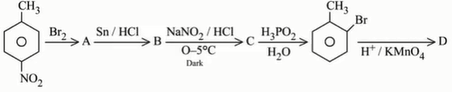
Identify A, D

Identify A, D

Figure for Q14

Answer & explanation+

Correct answer: option 4

The correct answer is Option (4) → A = 2-bromo-4-nitrotoluene, D = 2-bromobenzoic acid

The sequence starts from 4-nitrotoluene and uses the –\( \ce{NH2} \) group (made from –\( \ce{NO2} \)) only as a temporary group that is removed through a diazonium salt. First, bromination: –\( \ce{CH3} \) directs ortho/para and –\( \ce{NO2} \) directs meta, so both send Br to the carbon ortho to CH3. A is 2-bromo-4-nitrotoluene:

    \( \displaystyle \ce{CH3C6H4NO2 + Br2} \xrightarrow{\ce{FeBr3}} \ce{CH3C6H3(Br)NO2 + HBr} \)

Next, Sn/HCl reduces the nitro group to –\( \ce{NH2} \) (B, 3-bromo-4-methylaniline):

    \( \displaystyle \ce{CH3C6H3(Br)NO2 + 6[H]} \xrightarrow{\ce{Sn/HCl}} \ce{CH3C6H3(Br)NH2 + 2H2O} \)

Then nitrous acid at 273–278 K diazotises the amine (C):

    \( \displaystyle \ce{CH3C6H3(Br)NH2 + NaNO2 + 2HCl} \xrightarrow{\text{273-278 K}} \ce{CH3C6H3(Br)N2^+Cl^- + NaCl + 2H2O} \)

Hypophosphorous acid replaces the diazonium group by H, giving 2-bromotoluene:

    \( \displaystyle \ce{CH3C6H3(Br)N2^+Cl^- + H3PO2 + H2O -> CH3C6H4Br + N2 + H3PO3 + HCl} \)

Finally, acidified \( \ce{KMnO4} \) oxidises the side-chain –\( \ce{CH3} \) to –COOH, so D is 2-bromobenzoic acid:

    \( \displaystyle \ce{CH3C6H4Br + 3[O]} \xrightarrow{\ce{KMnO4/H+}} \ce{HOOCC6H4Br + H2O} \)

Option (4) shows this pair: the toluene with Br ortho to \( \ce{CH3} \) and \( \ce{NO2} \) para to it, and benzoic acid with Br ortho to COOH.

Why the other options are incorrect

  • Option (1), 3-bromo-4-nitrotoluene and 2-bromobenzaldehyde — Incorrect. A has Br ortho to \( \ce{NO2} \) (meta to \( \ce{CH3} \)), a position both groups disfavour, and D is drawn as 2-bromobenzaldehyde; \( \ce{KMnO4} \) oxidises the side chain right up to –COOH.

  • Option (2), 2-bromo-4-nitrotoluene and a nitro-substituted bromobenzoic acid — Incorrect. A is right, but D still carries the \( \ce{NO2} \) group; the nitro group was removed in the Sn/HCl, diazotisation and \( \ce{H3PO2} \) steps.

  • Option (3), a bromobenzoic acid and 2-bromo-3-nitrotoluene — Incorrect. The structures are in the wrong order (the benzoic acid is given as A), and the toluene drawn is 2-bromo-3-nitrotoluene, with \( \ce{NO2} \) next to Br instead of para to \( \ce{CH3} \).

NCERT (2026-27 edition):
Replacement by H – “Certain mild reducing agents like hypophosphorous acid (phosphinic acid) or ethanol reduce diazonium salts to arenes and themselves get oxidised to phosphorous acid and ethanal, respectively.”

Advertisement

Practise more on Organic: Amines

Chapter-wise mocks on the real NTA exam screen, with solutions and your rank. Your first mocks are free.

Start free mocks →

Advertisement

Next questions

  1. Two batteries each of internal resistance 5 Ω and emf 10 V are connected in parallel. Find the equivalent resistance and emf for the system.Physics · Current Electricity
  2. Two different positions of the same dice are shown, the six faces of which are numbered from 1 to 6. Select the number that will be on the…General Aptitude Test · Verbal Reasoning
  3. Assertion: According to big-bang hypothesis about 20 billion years ago universe was a big ball of only neutrons. Reason: Movement of these…Biology · Evolution
  4. India signed and ratified Kyoto protocol in which year?Political Science · Contemporary World Politics: Environment and Natural Resources
  5. Guru Makar Dhwaja Darogha, was conferred the Padma Shri award for his contribution to which form of dance in India?General Aptitude Test · General Knowledge
  6. Select the option that can be used as a one-word substitute for the underlined words in the given sentence. Today my dad will teach me how…English · One Word
  7. In a step down Transformer:Physics · Alternating Current
  8. Identify the correct statement:Sociology · Indian Society: Challenges of Cultural Diversity
  9. The standard reduction potentials, Eo for the half reactions are: Zn2+ + 2e- → Zn ; Eo = -0.76 V Fe2+ + 2e- → Fe ; Eo = -0.41 V What is the…Chemistry · Physical: Electro Chemistry
  10. Choose the most appropriate ANTONYM of the given word. PROTEANEnglish · Antonyms