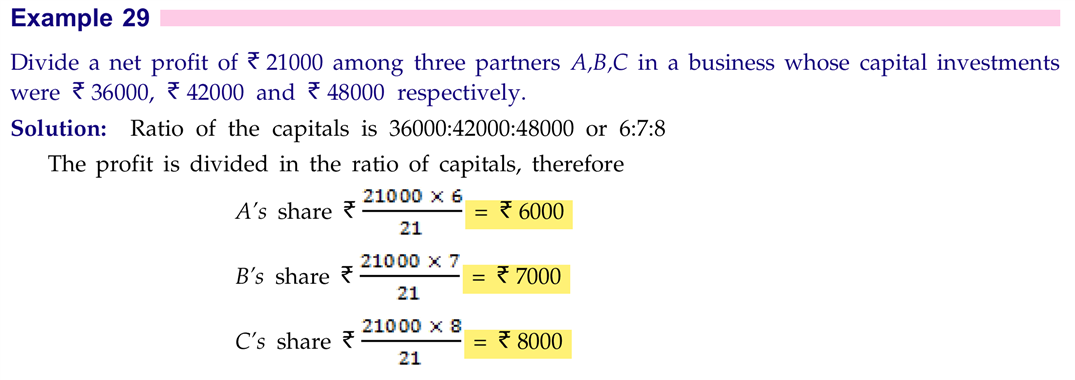
Mr. X, Mr. Y and Mr. Z invested Rs. 126000, Rs. 84000, and Rs. 210000, respectively in a business. If total share of profit is Rs. 242000, then their individual profits are respectively
Answer & explanation
Correct answer: option 2
The correct answer is Option (2) → Rs. 72,600, Rs. 48,400, Rs. 121,000
For the same period, the profit is shared in the ratio of the investments:
\(126000:84000:210000=3:2:5\) (dividing by 42000)
Total parts \(=3+2+5=10\)
One part \(=242000\div 10=24200\)
X: \(3\times 24200=72600\)
Y: \(2\times 24200=48400\)
Z: \(5\times 24200=121000\)
In the order X, Y, Z (“respectively”), the profits are Rs. 72,600, Rs. 48,400 and Rs. 1,21,000.
Why the other options are incorrect
Option (1) Rs. 48600, Rs. 72400, Rs. 120000 — Incorrect. These add up to Rs. 241000, not Rs. 242000, and are not in the ratio 3 : 2 : 5.
Option (3) Rs. 121000, Rs. 48400, Rs. 72600 — Incorrect. The shares of X and Z are interchanged: Rs. 121000 is the share of Z, who invested the most.
Option (4) Rs. 121000, Rs. 72600, Rs. 48400 — Incorrect. These are the right amounts in the reverse order (Z, X, Y), not X, Y, Z.
CBSE Applied Mathematics (Class XII):
Partnership