
Ethers are class of organic compounds that contain ether group – an oxygen atom connected to two alkyl groups or aryl groups. They have the general formula R – O – R′, where R and R′ represents the alkyl or aryl groups. Ether, like water have a tetrahedral geometry i.e., oxygen is sp3 hybridised. The C – O – C bond angle in ethers is slightly greater than the tetrahedral angle due to repulsive interactions between the two bulky groups when they are attached to oxygen.
Answer & explanation
Correct answer: option 1
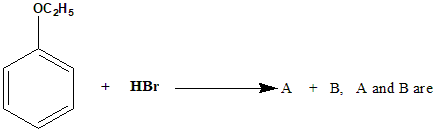
The correct answer is Option (1) → phenol + C2H5Br
The aryl–O bond has partial double bond character, and the sp2 carbon of the ring is not attacked by \( \ce{Br^{-}} \). So \( \ce{Br^{-}} \) attacks the ethyl group of the protonated ether:
\( \displaystyle \ce{C6H5-O-C2H5 + HBr -> C6H5OH + C2H5Br} \)
Why the other options are incorrect
Option (2) bromobenzene + C2H5OH — Incorrect. This needs the aryl–O bond to break, which does not happen; phenol is not converted into bromobenzene either.
Option (3) o-bromophenetole + H2O — Incorrect. This is ring bromination, which needs \( \ce{Br2} \), not HBr.
Option (4) o- and p-bromophenetole — Incorrect. These are the products of bromination of phenetole with \( \ce{Br2} \) (electrophilic substitution), not of cleavage by HBr.
NCERT (2026-27 edition):
Chemical Reactions – …
