Match List-I with List-II
| LIST I | LIST II |
| A. Stephen reduction |  |
| B. Clemmensen reduction |  |
| C. Wolff-Kishner reduction |  |
| D. Rosenmund reduction |  |
Choose the correct answer from the options given below:
Answer & explanation
Correct answer: option 1
The correct answer is Option (1) → A-III, B-II, C-IV, D-I
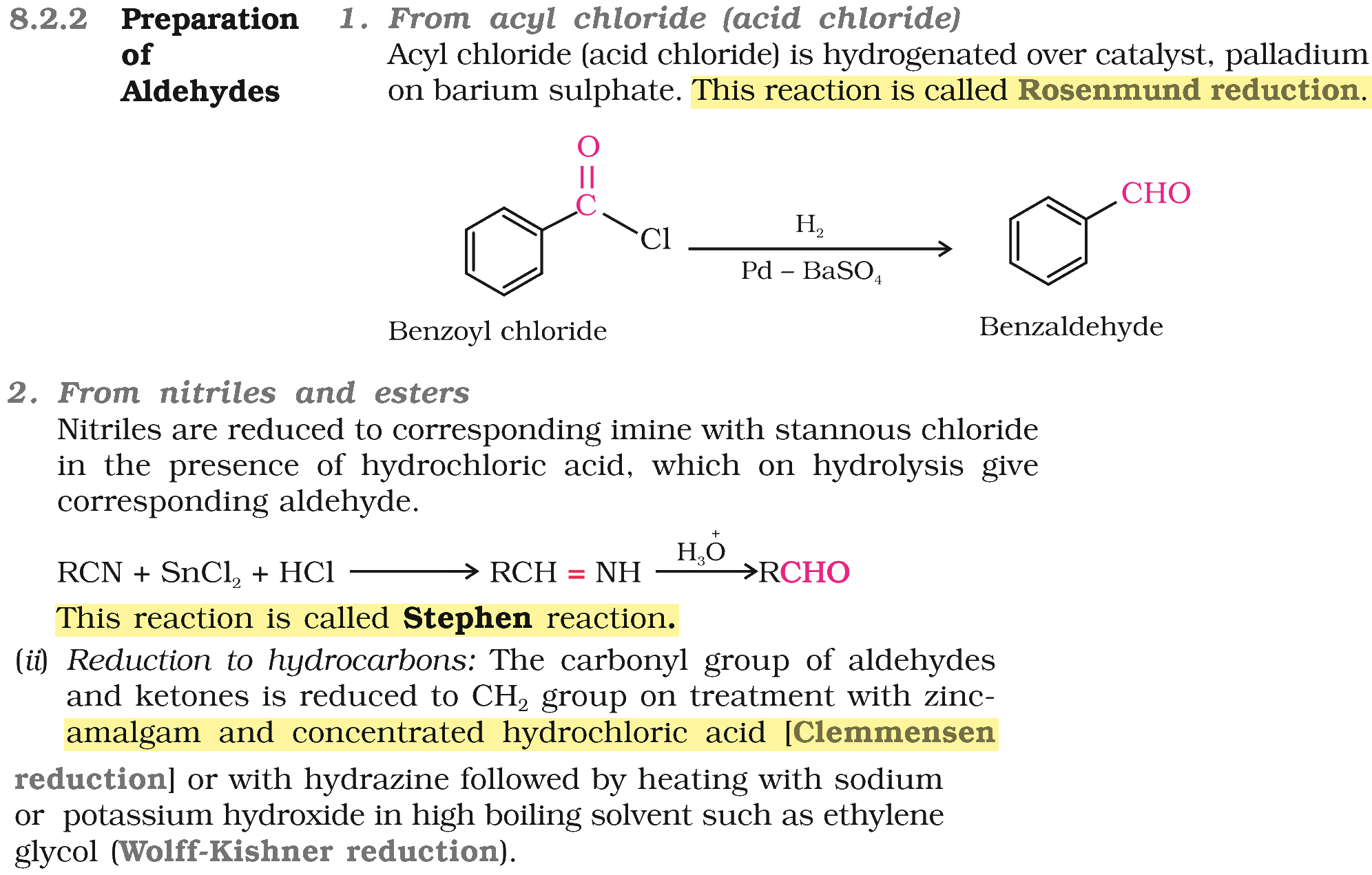
All four are named reductions used with carbonyl compounds and their derivatives. Two of them stop at the aldehyde (Stephen, Rosenmund) and two reduce C=O all the way to \( \ce{CH2} \) (Clemmensen, Wolff–Kishner). The reagent on the arrow identifies each one.
A. Stephen reduction — a nitrile is reduced by \( \ce{SnCl2} \) and HCl to the imine, which is hydrolysed to the aldehyde. This matches III: \( \ce{RCN} \xrightarrow{\ce{SnCl2/HCl}} \ce{RCH=NH} \xrightarrow{\ce{H3O+}} \ce{RCHO} \).
B. Clemmensen reduction — zinc amalgam and concentrated HCl reduce >C=O to >\( \ce{CH2} \). This matches II: \( \ce{>C=O} \xrightarrow[\ce{HCl}]{\ce{Zn-Hg}} \ce{>CH2 + H2O} \).
C. Wolff-Kishner reduction — the carbonyl compound forms a hydrazone with hydrazine, which is heated with KOH in ethylene glycol and loses \( \ce{N2} \). This matches IV: \( \ce{>C=O} \xrightarrow{\ce{NH2NH2}} \ce{>C=NNH2} \xrightarrow[\Delta]{\text{KOH/ethylene glycol}} \ce{>CH2 + N2} \).
D. Rosenmund reduction — an acyl chloride is hydrogenated over palladium on barium sulphate (a poisoned catalyst) to the aldehyde. This matches I: \( \ce{C6H5COCl + H2} \xrightarrow{\ce{Pd/BaSO4}} \ce{C6H5CHO + HCl} \).
Shortcut: D-I (Pd/\( \ce{BaSO4} \) on an acyl chloride) appears only in Options (1) and (4), and of these only Option (1) has A-III.
NCERT (2026-27 edition):
Preparation of Aldehydes