
CUETMOCK
  • Pricing
  • Mentors
Log inStart freeStart free mocks→

First test, then trust

Try a free CUET mock test.

Join 5,00,000+ students who rehearsed exam day on the exact NTA screen before sitting CUET. On the web and on Android.

Start free mocks →Get the Android app
CUETMOCK

India's #1 CUET Mock Test Platform. Original NCERT-based questions on the exact NTA exam screen — trusted by 5,00,000+ students since CUET 2022.

Get it onGoogle PlayScan to download the CUETMOCK app

Mock tests

  • CUET mock test series
  • Commerce mocks
  • Humanities (Arts) mocks
  • Science mocks
  • Languages & GAT mocks
  • Free practice questions
  • Pricing

Resources

  • CUET exam guide
  • CUET syllabus
  • Universities accepting CUET
  • Expert blogs
  • News & notifications
  • Webinars & counselling
  • CUET score calculator
  • How we estimate your rank
  • FAQs

Company

  • About us
  • Our leadership & team
  • Our toppers
  • Mentors
  • For schools
  • Contact us
  • Terms
  • Privacy
  • Refund policy

Talk to us

+91 7696 6630 56info@cuetmock.comWhatsApp us

Our other platforms

  • JEE Mock — For IIT-JEE aspirants
  • NEET Mock — For NEET aspirants

Newsletter

Exam updates, study material and offers — no spam.

© 2026 NYC Ventures Pvt. Ltd.

701-702, Royal Business Park, Zirakpur, Punjab - 140603

  • Terms of use
  • Privacy policy
  • Refund policy
  • Contact us

iCUETMOCK is an independent preparation platform, not affiliated with the National Testing Agency (NTA). Always check exam details on the official NTA website.

  • Home
  • Mock tests
  • CUET guide
  • Pricing
  • Log in
Home/Practice questions/Chemistry
ChemistryOrganic: Alcohols, Phenols and Ethers

The major products for the following reaction will be

The major products for the following reaction will be

Figure for Q2

Answer & explanation+

Correct answer: option 1

The correct answer is Option (1) → benzyl iodide and phenol

Ethers are cleaved by hydrogen iodide. The ether oxygen is first protonated, and then the iodide ion breaks one C–O bond. Which C–O bond breaks depends on the groups attached to oxygen:

  • O–aryl bond: in an alkyl aryl ether, the bond between oxygen and the benzene ring has partial double bond character (resonance of the O lone pair with the ring) and the ring carbon is sp2. This bond is not broken, so the aryl part always ends up as a phenol.

  • O–alkyl bond: this bond breaks, and the alkyl group becomes an alkyl iodide. A benzyl group breaks off very easily, because the benzyl carbocation is stabilised by resonance.

The given ether is benzyl phenyl ether, \( \ce{C6H5CH2-O-C6H5} \):

    \( \displaystyle \ce{C6H5CH2-O-C6H5 + HI -> C6H5CH2I + C6H5OH} \)

So the major products are benzyl iodide (\( \ce{C6H5CH2I} \)) and phenol (\( \ce{C6H5OH} \)).

Why the other options are incorrect

  • Option (2) benzyl alcohol and benzyl iodide — Incorrect. Both products contain a benzyl group, but the ether has only one benzyl group; its other group is a phenyl group, which gives phenol.

  • Option (3) phenol and iodobenzene — Incorrect. Iodobenzene would need the strong O–aryl bond to break, and both products lack the \( \ce{CH2} \) group of the benzyl part.

  • Option (4) benzyl alcohol and benzyl iodide — Incorrect. The same pair as Option (2), so it is wrong for the same reason.

Note: It seems that there is a mistake in the original NTA paper. Option (2) and Option (4) are printed as the same pair of structures, benzyl alcohol and benzyl iodide.

NCERT (2026-27 edition):
Cleavage of C–O Bond in Ethers
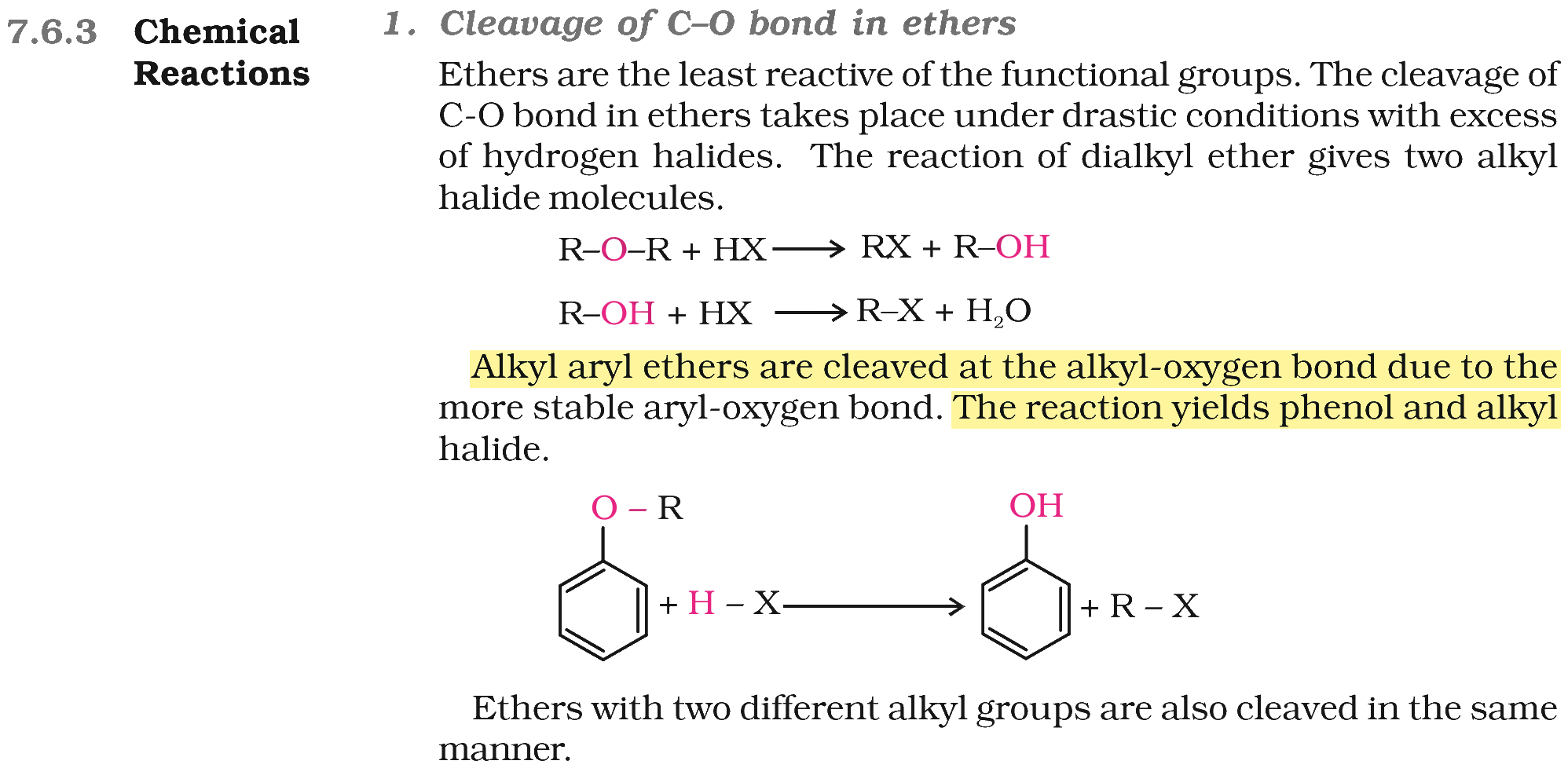
Textbook extract

Advertisement

Practise more on Organic: Alcohols, Phenols and Ethers

Chapter-wise mocks on the real NTA exam screen, with solutions and your rank. Your first mocks are free.

Start free mocks →

Advertisement

Next questions

  1. Two point charges ±200 μC are placed at a distance of 2 mm from each other in uniform electric field of 10^5 N/C such that the line joining…Physics · Electric Charges and Fields
  2. Select the option that is related to the third number in the same way as the second number is related to the first number. 166 : 415 : : 25…General Aptitude Test · General Ability
  3. Select the option that is similar in meaning to the underlined word. He gave a concise explanation of the company's retirement plan.English · Synonyms
  4. If the rate of compound interest is 20% per annum, compounded half-yearly, then what will be the interest on a principal of ₹100000 for two…General Aptitude Test · Numerical Ability
  5. Which of the following is correctly matched?History · Modern India: Colonial cities
  6. Name the Chinese pilgrim who visited India.History · Ancient India: Thinkers, Beliefs and Buildings
  7. सूची-I का सूची-II से मिलान कीजिए। सूची-I सूची-II (A) कमल (I) केशरी (B) सिंह (II) तामरस (C) पावक (III) निशापति (D) सुधाधर (IV) कृशानु नीचे द…Hindi · Synonyms
  8. Which of the following is a chelate complex?Chemistry · Inorganic: Coordination Compounds
  9. Given below are four jumbled sentences. Out of the given options pick the one that gives their correct order. A. Can I borrow your camera?B…English · Arrange in Meaningful Sequence
  10. What will be the final product when toluene reacts with chlorine in presence of U.V. light at temperature followed by reaction with water i…Chemistry · Organic: Aldehydes, Ketones and Carboxylic Acids