DEMONETISATION
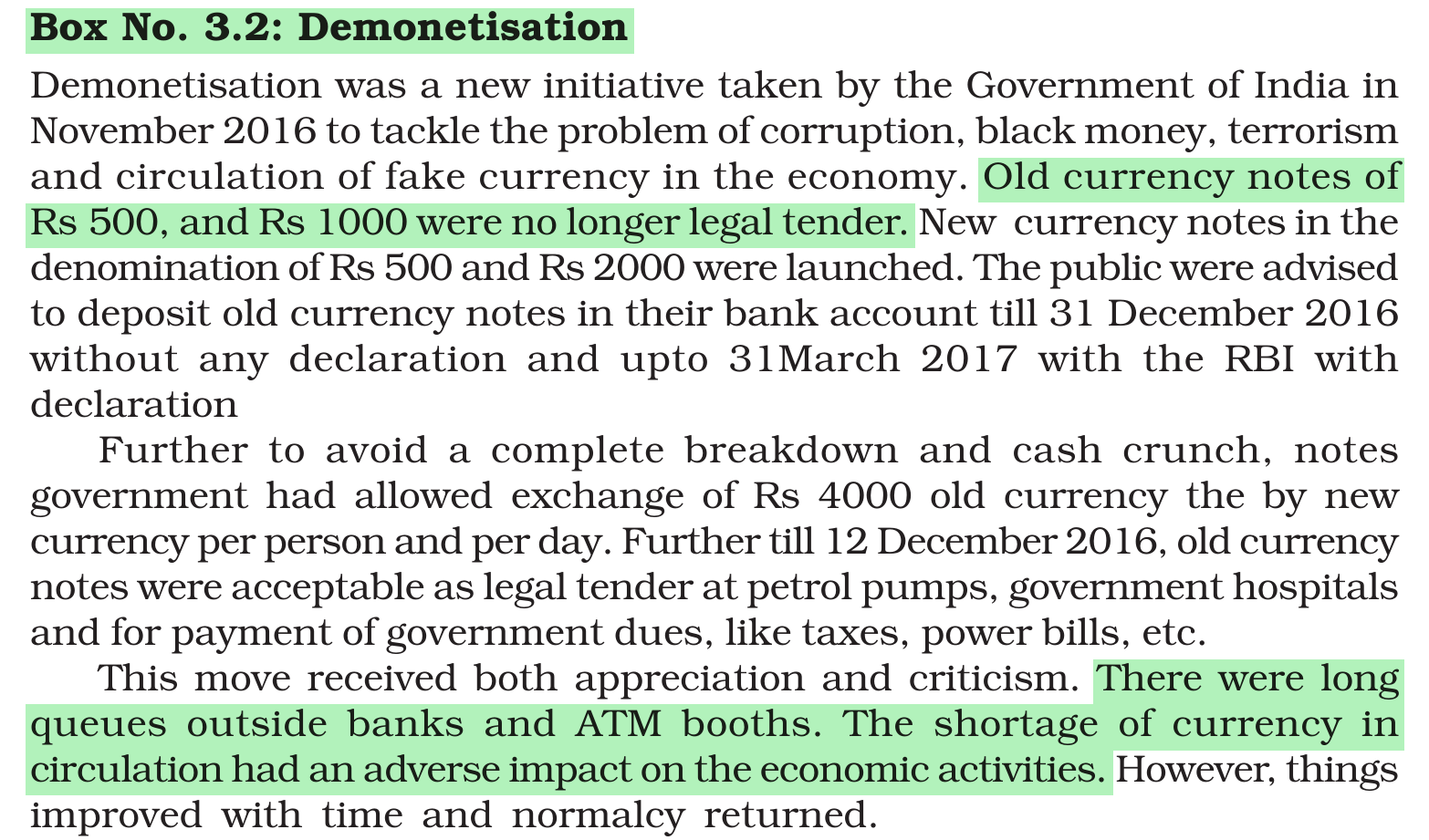
Demonetisation was a initiative taken by the Government of India in November 2016 to tackle the problem of corruption, black money, terrorism and circulation of fake currency in the economy. Old currency notes of Rs 500, and Rs 1000 were no longer legal tender. New currency notes in the denomination of Rs 500 and Rs 2000 were launched. The public were advised to deposit old currency notes in their bank account till 31 December 2016 without any declaration and upto 31 March 2017 with the RBI with declaration.
Further to avoid a complete breakdown and cash crunch, notes government had allowed exchange of Rs 4000 old currency the by new currency per person and per day. Further till 12 December 2016, old currency notes were acceptable as legal tender at petrol pumps, government hospitals and for payment of government dues, like taxes, power bills, etc.
This move has had positive impact also. It improved tax compliance as a large number of people were bought in the tax ambit. The savings of an individual were channelised into the formal financial system. As a result, banks have more resources at their disposal which can be used to provide more loans at lower interest rates. It is a demonstration of State's decision to put a curb on black money, showing that tax evasion will no longer be tolerated. Tax evasion will result in financial penalty and social condemnation. Tax compliance will improve and corruption will decrease. Demonetisation could also help tax administration in another way, by shifting transactions out of the cash economy into the formal payment system. Households and firms have begun to shift from cash to electronic payment technologies.
What was the immediate impact of demonetization on the economy?
Answer & explanation
Correct answer: option 4
The correct answer is Option (4) → Decrease in aggregate demand.
Aggregate demand is the total planned spending on final goods and services. Right after demonetisation, this spending fell.
The old notes of Rs 500 and Rs 1000 stopped being legal tender, that is, money that no citizen can refuse in payment. People stood in long queues outside banks and ATMs. With a shortage of currency, people and firms had less cash in hand, so they spent less.
Note: The passage printed in the paper leaves out some lines of the box in the NCERT book. They say that there were long queues outside banks and ATMs, and that the shortage of currency had an adverse impact on economic activities. The book does not say in so many words that aggregate demand fell; this follows from the reasoning above.
NCERT (2026-27): Introductory Macroeconomics — Chapter 3: Money and Banking
|