Read the following passage and answer the question.
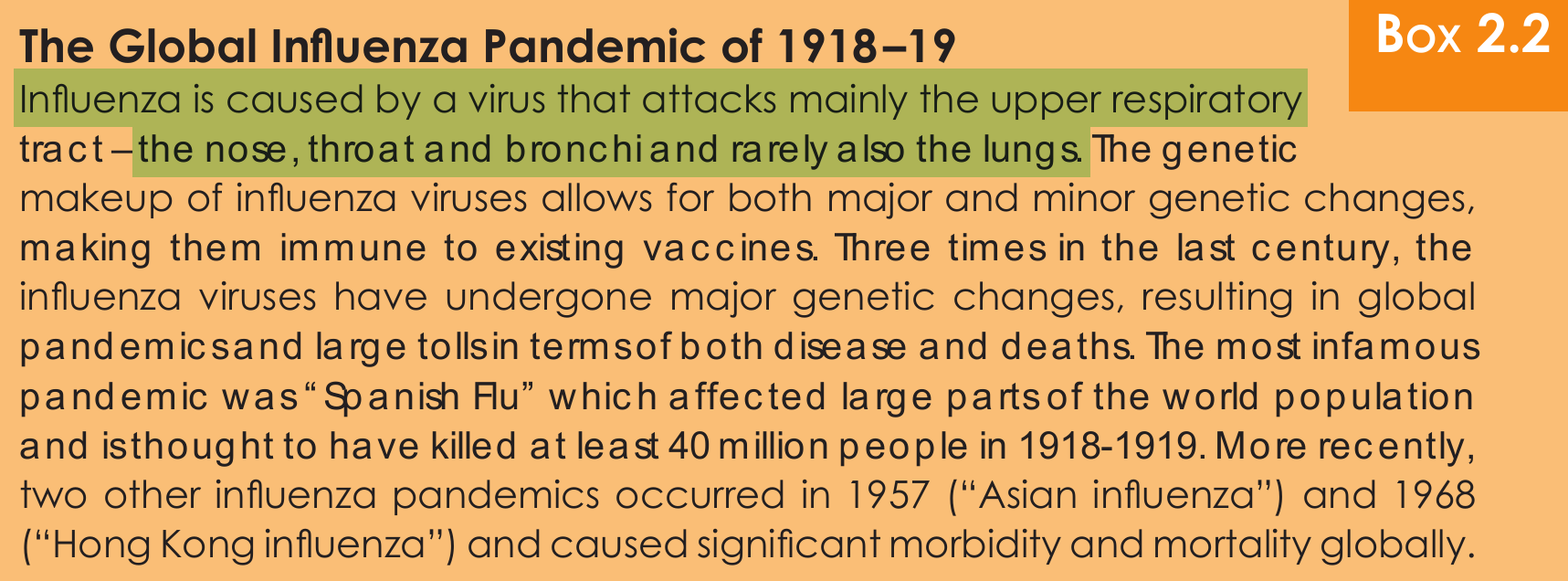
Influenza is caused by a virus that attacks mainly the upper respiratory tract-the nose, throat and bronchi and rarely also the lungs. The genetic make up of Influenza virus allows for both major and minor genetic changes, making them immune to existing vaccines. Three times in the last century, the Influenza virus have undergone major genetic changes, resulting in global Pandemics and large tolls in terms of both disease and deaths. The most infamous pandemic was "Spanish Flu" which affected large parts of the world population and is thought to have killed at least 40 million people in 1918-19. More recently, two other Influenza pandemics occurred in 1957 (Asian Influenza) and 1968 (Hong Kong Influenza).
The Influenza virus affects:
Answer & explanation
Correct answer: option 1
The correct answer is Option (1) → Upper respiratory tract and rarely the lungs also
Note: The given answer is as per the official NTA Answer Key. However, Option (3) can also be considered correct, as explained below.
Option (1) Upper respiratory tract and rarely the lungs also — Correct as per NTA. The influenza virus attacks mainly the upper respiratory tract, that is, the nose, throat and bronchi, and rarely also the lungs.
Option (2) nose, throat and majorly the lungs — Incorrect. The nose and throat are right, but the lungs are attacked rarely, not mainly. One wrong word turns the line false.
Option (3) nose, throat and bronchi — Can also be considered correct. The nose, throat and bronchi make up the upper respiratory tract, the part the virus attacks mainly. The option only leaves out the lungs, which the virus attacks rarely.
Option (4) upper respiratory tract except lungs — Incorrect. The lungs are not left out altogether: the virus rarely, but sometimes, attacks the lungs too.
NCERT: Indian Society — Chapter 2: The Demographic Structure of the Indian Society, Box 2.2 (2025-26)
|