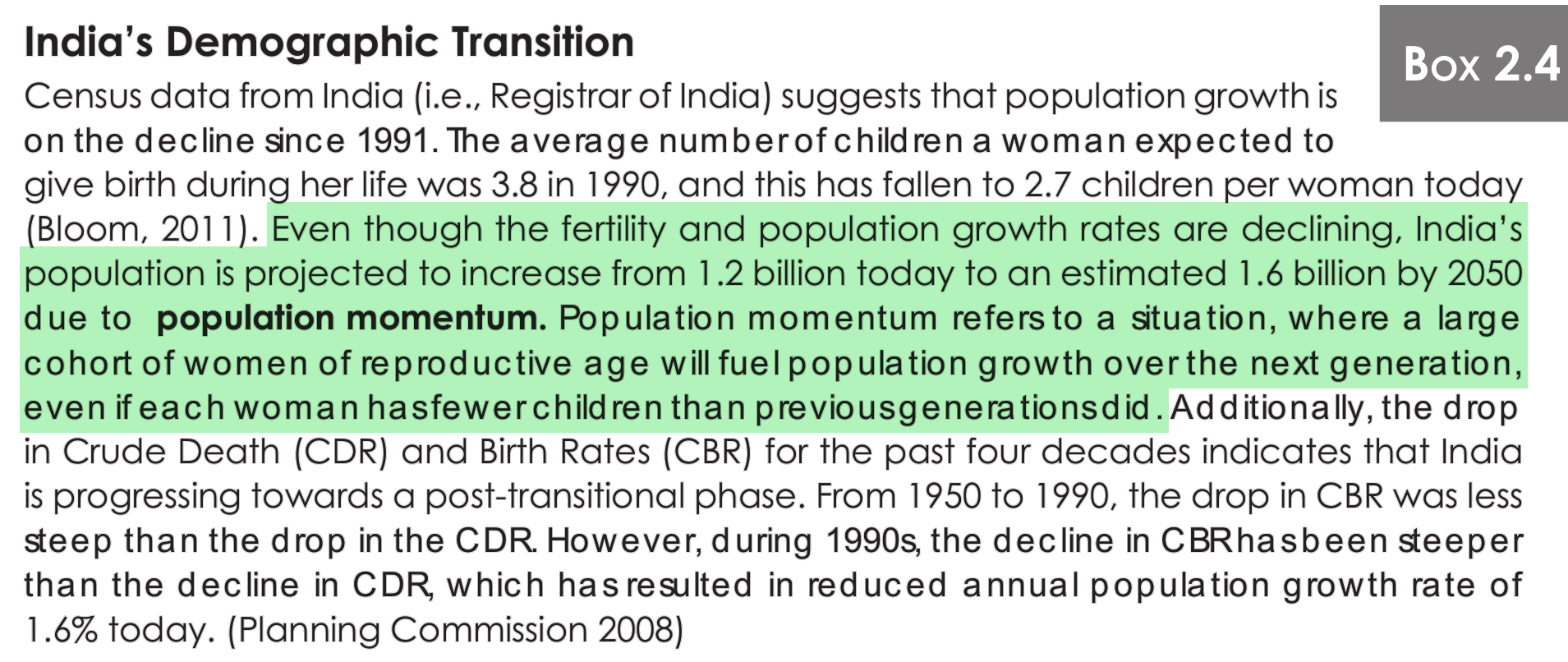
When a large cohort of women of reproductive age fuel population growth over the next generation, even if each woman has fewer children than previous generations did, what is it known as?
Answer & explanation
Correct answer: option 4
The correct answer is Option (4) → Population Momentum
Option (1) Demographic Dividend — Incorrect. The demographic dividend is the benefit from a larger proportion of workers relative to non-workers, when the dependency ratio falls. It is about the gain from the age structure, not about growth that goes on while each woman has fewer children.
Option (2) Total Fertility Rate — Incorrect. The total fertility rate is the average number of children a woman has; a TFR of 1.7 means the average woman has 1.7 children. It is a measure, and the question says this measure is falling while the population still grows.
Option (3) Fertility Rate — Incorrect. The fertility rate is the number of live births per 1000 women in the child-bearing age group, usually 15 to 49 years. It counts births; it does not name the situation the question describes.
Option (4) Population Momentum — Correct. When a large cohort of women is of reproductive age, the population keeps growing over the next generation even if each woman has fewer children, because so many women are having children at the same time.
NCERT: Indian Society — Chapter 2: The Demographic Structure of the Indian Society (2025-26)
|