
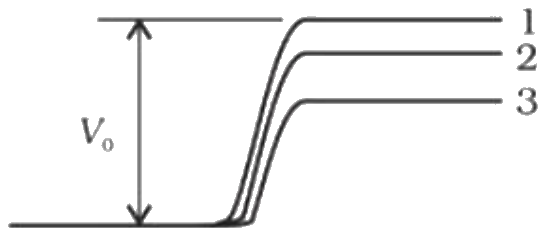
The following curves, namely \( 1 \), \( 2 \) and \( 3 \) represent the potential barrier of a p-n junction diode under forward bias for various bias voltages (1) \( V_{1} \), (2) \( V_{2} \) and (3) \( V_{3} \). Given that \( V_{0} \) is built-in barrier potential, identify the correct relations among the bias voltages.
Answer & explanation
Correct answer: option 2
The correct answer is Option (2) → \( V_{1} = 0\ \mathrm{V} \) and \( V_{3} \gt V_{2} \)
Under forward bias \( V \) the applied voltage opposes the built-in potential, so the barrier height falls to \( V_{0} - V \). A larger forward bias gives a lower barrier.
Readings from the figure:
Curve 1: barrier height equal to \( V_{0} \), so \( V_{1} = 0 \) V (no bias).
Curve 2: lower than curve 1.
Curve 3: the lowest barrier, so the largest forward bias.
\( V_{0} - V_{3} \lt V_{0} - V_{2} \Rightarrow V_{3} \gt V_{2} \)
NCERT (2026-27):
p-n Junction Diode Under Forward Bias – “… The direction of the applied voltage (V) is opposite to the built-in potential V0. As a result, the depletion layer width decreases and the barrier height is reduced [Fig. 14.13(b)]. The effective barrier height under forward bias is (V0 – V).”