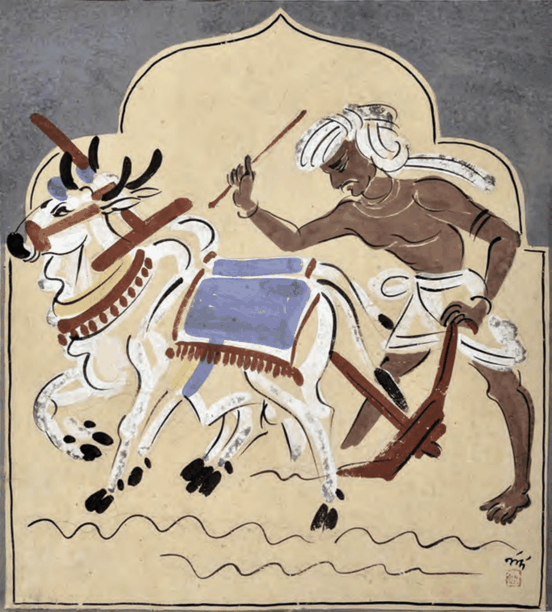
Nandalal Bose made the poster Tiller of the Soil for the Haripura Congress. Consider the following statements on it and on later modern Indian art:
(A) The background of the poster has an arch.
(B) The poster shows a farmer ploughing a field.
(C) Later modern Indian art keeps moving between internationalism and the indigenous.
(D) The poster was painted in thin tempera in a bold cursory style.
Choose the correct answer from the options given below:
Answer & explanation
Correct answer: option 2
The correct answer is Option (2) → (A), (B) and (C) only
(A) The background of the poster has an arch. — Correct. The background of the poster has an arch.
(B) The poster shows a farmer ploughing a field. — Correct. The panel shows a farmer ploughing a field, the daily work of a common man in a village.
(C) Later modern Indian art keeps moving between internationalism and the indigenous. — Correct. The legacy of the nationalist artists left later modern Indian art moving between internationalism, drawing ideas from the West, and the indigenous, staying true to its own legacy and tradition.
(D) The poster was painted in thin tempera in a bold cursory style. — Incorrect. Bose used thick tempera in a bold cursory style, with broad brushwork.
Note: This topic was not named in the CUET 2026 syllabus, but it was part of the NCERT chapter. In 2025 and 2026, NTA also asked questions on topics in NCERT that the CUET syllabus did not name. So our mocks have questions from every part of the NCERT chapter, to give you enough practice. Read the whole chapter, not only the sub-topics named in the syllabus.
NCERT (2026-27): “Tiller of the Soil This is one of the panels made by Nandalal Bose in 1938 for the Haripura Congress. In this panel, a farmer is shown ploughing a field — the daily activity of a common man and in a village. To capture the essence of village life in his Haripura panels, Bose made pen-and-ink brush studies of local villagers. He used thick tempera in a bold cursory style and broad brushwork. This technique and style was reminiscent of the folk art practice of patuas or scroll painters. Folk style is purposely used to represent the rural life. It also conveys political statement of Gandhi’s idea of village. The background of the poster has an arch.…”
“Different Concepts of Modernism: Western and Indian …Nationalist artists, while accepting these changes, continued to assert more Indian taste in art and even accepted a larger Asian identity for a while. This legacy was going to leave a deep impact on the later history of modern Indian art. Therefore, it will keep moving from internationalism, i.e., draw ideas from the West, and indigenous, i.e., to be true to one’s own legacy and tradition.” |