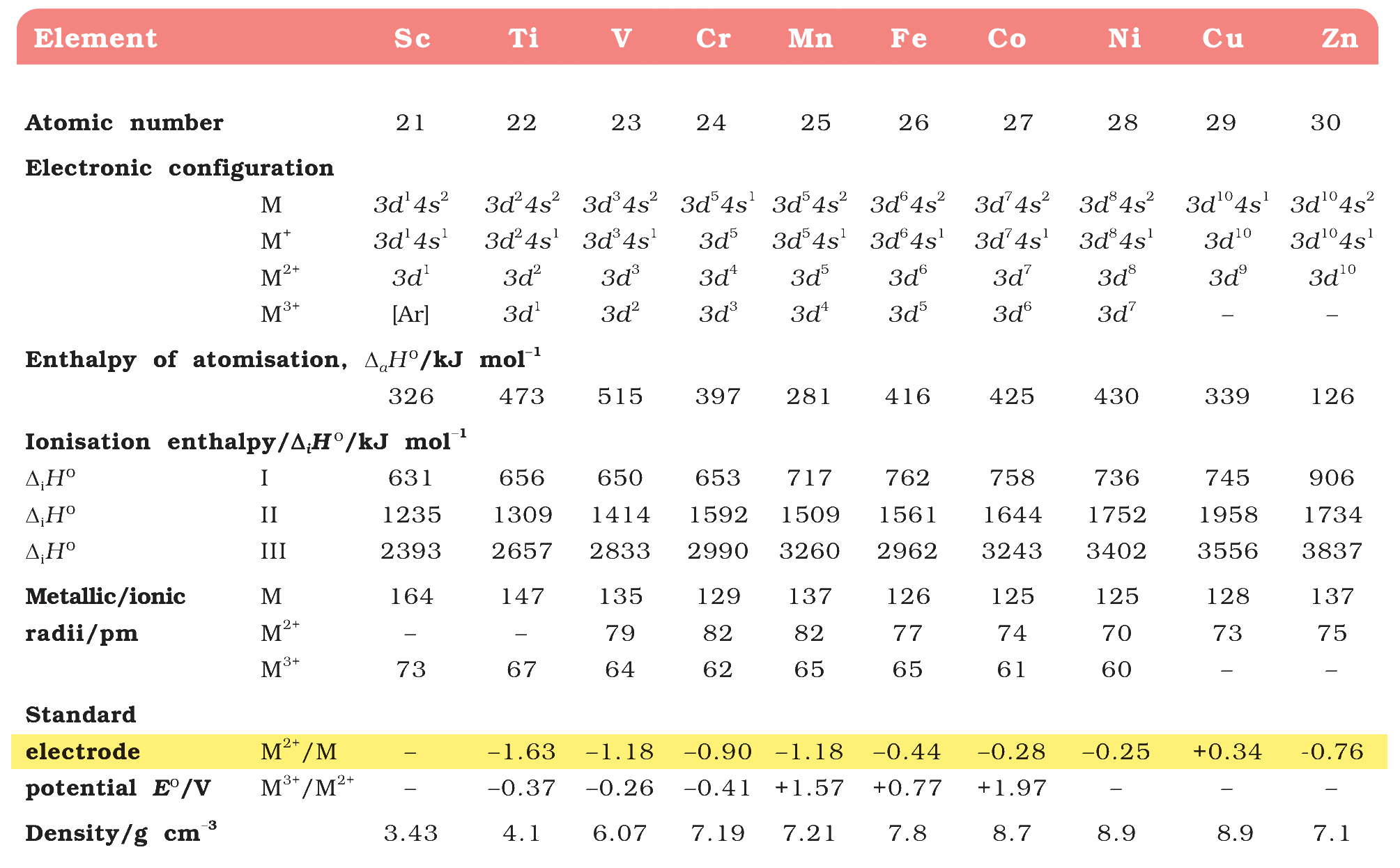
Arrange the following metals in increasing order of their standard electrode potential, E°(M2+/M).
(A) Iron
(B) Copper
(C) Manganese
(D) Nickel
Choose the correct answer from the options given below:
Answer & explanation
Correct answer: option 1
The correct answer is Option (1) → (C), (A), (D), (B)
Across the first transition series the E°(M2+/M) values become less negative, because the sum of the first and second ionisation enthalpies generally increases. A less negative value means a smaller tendency to form the M2+ ion.
(C) Manganese — First (lowest), −1.18 V. Its value is more negative than the trend predicts, because Mn2+ has the stable half-filled d5 configuration.
(A) Iron — Second, −0.44 V.
(D) Nickel — Third, −0.25 V. Its value is more negative than the general trend predicts, but it is still less negative than that of iron (−0.44 V).
(B) Copper — Fourth (highest), +0.34 V. Copper is the only metal of the series with a positive E°, so it cannot liberate H2 from acids.
NCERT (2026-27 edition):
4.3.8 Chemical Reactivity and E° Values – “…The Eo values for M2+/M (Table 4.2) indicate a decreasing tendency to form divalent cations across the series. This general trend towards less negative Eo values is related to the increase in the sum of the first and second ionisation enthalpies. It is interesting to note that the Eo values for Mn, Ni and Zn are more negative than expected from the general trend. Whereas the stabilities of half-filled d subshell (d5) in Mn2+ and completely filled d subshell (d10) in zinc are related to their Eo values; for nickel, Eo value is related to the highest negative enthalpy of hydration.”
4.3.5 Trends in the M2+/M Standard Electrode Potentials – “The unique behaviour of Cu, having a positive Eo, accounts for its inability to liberate H2 from acids.”
Table 4.2: Electronic Configurations and some other Properties of the First Series of Transition Elements