
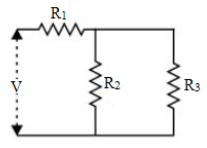
For the same power to be dissipated in each of the three resistors \( R_1 \), \( R_2 \) and \( R_3 \) connected as shown in the figure, their values must be related as
Answer & explanation
Correct answer: option 3
The correct answer is Option (3) → \( R_2=R_3 \) and \( R_1=\frac{R_2}{4} \)
From the figure, \( R_2 \) and \( R_3 \) are in parallel, so they have the same potential difference \( V_p \). \( R_1 \) is in series with this pair, so it carries the whole current \( I \). The power in a resistor is \( V^{2}/R \) or \( I^{2}R \).
Equal power in \( R_2 \) and \( R_3 \), with the same \( V_p \), gives:
\( \displaystyle \frac{V_p^{2}}{R_2}=\frac{V_p^{2}}{R_3} \)
\( \Rightarrow\; R_2=R_3 \)
So the current \( I \) divides equally. Each of \( R_2 \) and \( R_3 \) carries \( I/2 \). Equal power in \( R_1 \) and \( R_2 \) gives:
\( \displaystyle I^{2}R_1=\left(\frac{I}{2}\right)^{2}R_2 \)
\( \displaystyle \Rightarrow\; R_1=\frac{R_2}{4} \)