
Read the passage carefully and answer the Questions.
Aldehydes, carboxylic acids and ketones are widespread in the animal and plant kingdoms. They play a pivotal role in various biochemical processes of life. Their presence in nature adds fragrance and flavor. These compounds are widely used in food products, pharmaceuticals, paints, resins and other important product industries. These compounds are prepared by various laboratory methods, which mainly include oxidation, formylation, acylation and reduction. Due to the polar nature of the carbonyl group in aldehydes and ketones, they can exhibit different reactions like nucleophilic addition. They do exhibit redox and various condensation reactions which lead to the formation of various important compounds. On the other hand, the carboxylic acids are mainly prepared by oxidation and hydrolysis of different compounds. The carboxylic acid consists of a carbonyl group and the hydroxy group (attached to the carbonyl carbon atom). This makes it possible for the carboxylic acid to participate in various chemical reactions which involve cleavage of the C-OH bond and the O-H bond along with the reactions involving the complete -COOH group.
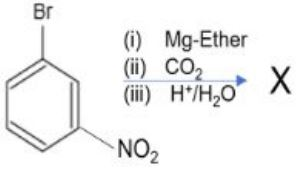
Identify the final product (X) of the chemical reaction obtained from the following transformation:
Answer & explanation
Correct answer: option 3
The correct answer is Option (3) → 3-Nitrobenzoic acid
A Grignard reagent adds to carbon dioxide and, after acid work-up, gives a carboxylic acid with one carbon more than the halide. The –COOH group takes the place where the halogen was. The given reagents carry out three changes in order.
First, magnesium in dry ether inserts between the ring carbon and bromine and forms the Grignard reagent, 3-nitrophenylmagnesium bromide:
\( \displaystyle 3\text{-}\ce{O2N-C6H4-Br + Mg} \xrightarrow{\text{dry ether}} 3\text{-}\ce{O2N-C6H4-MgBr} \)
Next, the carbanion-like carbon of the Grignard reagent attacks the carbon of \( \ce{CO2} \) (nucleophilic addition), giving the magnesium salt of the acid:
\( \displaystyle 3\text{-}\ce{O2N-C6H4-MgBr + CO2 -> 3-O2N-C6H4-COOMgBr} \)
Finally, dilute acid protonates the carboxylate:
\( \displaystyle 3\text{-}\ce{O2N-C6H4-COOMgBr} \xrightarrow{\ce{H+/H2O}} 3\text{-}\ce{O2N-C6H4-COOH + Mg(OH)Br} \)
The nitro group stays at position 3, so X is 3-nitrobenzoic acid.
Note: It seems that there is a mistake in the original NTA paper, which prints a Grignard reaction on 1-bromo-3-nitrobenzene; a Grignard reagent cannot be prepared from a compound carrying a nitro group, because the nitro group reacts with it.
NCERT (2026-27 edition):
From Grignard Reagents
