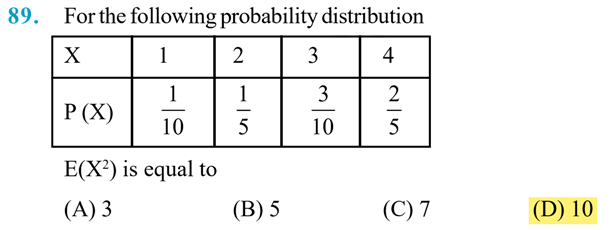
For the following probability distribution:
| X | 1 | 2 | 3 | 4 |
| P(X) | 1/10 | 1/5 | 3/10 | 2/5 |
\(E(X^2)\) is equal to:
Answer & explanation
Correct answer: option 4
The correct answer is Option (4) → 10
By definition, \(E(X^2) = \sum x^2\,P(X = x)\): each value is squared and multiplied by its probability.
\( \displaystyle E(X^2) = 1^2 \times \frac{1}{10}+2^2 \times \frac{1}{5}+3^2 \times \frac{3}{10}+4^2 \times \frac{2}{5} \)
\( \displaystyle = \frac{1}{10}+\frac{8}{10}+\frac{27}{10}+\frac{64}{10} \)
\( \displaystyle = \frac{100}{10} = 10 \)
NCERT Exemplar:
Probability