Target Exam

CUET

Subject

Chemistry

Chapter

Physical: Solutions

Question:

Which of the following is the correct formula of a colligative property?

Options:

$\frac{{P_1}^o-P_1}{{P_1}^o}=x_1$

$ΔT_b=\frac{K_b×1000×w_2}{M_1×w_1}$

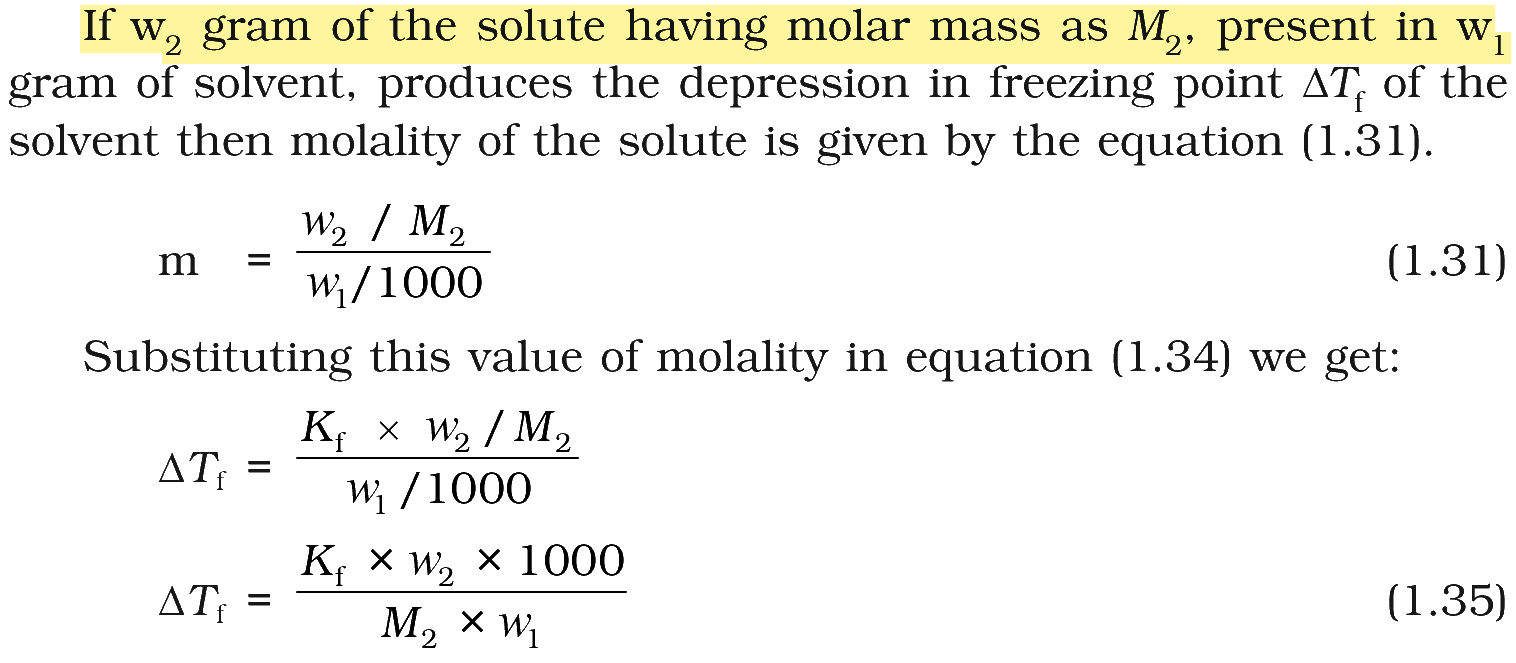
$ΔT_f=\frac{K_f×1000×w_2}{M_2×w_1}$

$\pi=ΔT_fRT$

Correct Answer:

$ΔT_f=\frac{K_f×1000×w_2}{M_2×w_1}$

Explanation:

The correct answer is Option 3.  $ΔT_f=\frac{K_f×1000×w_2}{M_2×w_1}$.

Colligative properties are properties of solutions that depend on the number of solute particles present in the solution, not on the identity or nature of those particles. The key colligative properties include:

(I) Relative lowering of vapor pressure

(II) Elevation of boiling point

(III) Depression of freezing point

(IV)Osmotic pressure

Now, let's examine the options given:

1. \( \frac{P_1^o - P_1}{P_1^o} = x_1 \):

This formula attempts to describe the relative lowering of vapor pressure. The correct relationship is:

\(\frac{P_1^o - P_1}{P_1^o} = x_2\)

Where:

\( P_1^o \) is the vapor pressure of the pure solvent.

\( P_1 \) is the vapor pressure of the solvent in the solution.

\( x_2 \) is the mole fraction of the solute (not the solvent).

This equation is derived from Raoult's Law, which states that the relative lowering of vapor pressure is proportional to the mole fraction of the solute in a dilute solution. The formula provided has \( x_1 \), which is the mole fraction of the solvent, instead of \( x_2 \), the mole fraction of the solute. The correct colligative property would relate to the solute's mole fraction.

Thus, this option is incorrect.

2. \( \Delta T_b = K_b \times \frac{1000 \times w_2}{M_1 \times w_1} \):

This formula is meant to describe the elevation of boiling point, which is another colligative property. The correct formula is:

\(\Delta T_b = K_b \times \frac{1000 \times w_2}{M_2 \times w_1}\)

Where:

\( \Delta T_b \) is the boiling point elevation.

\( K_b \) is the ebullioscopic constant (boiling point elevation constant).

\( w_2 \) is the mass of the solute.

\( M_2 \) is the molar mass of the solute.

\( w_1 \) is the mass of the solvent.

In the given formula, it incorrectly uses \( M_1 \) (which would refer to the molar mass of the solvent) instead of \( M_2 \), which should represent the molar mass of the solute. The formula must involve the molar mass of the solute to correctly calculate the boiling point elevation.

Thus, this option is incorrect.

3. \( \Delta T_f = K_f \times \frac{1000 \times w_2}{M_2 \times w_1} \):

This is the correct formula for the depression of freezing point, a key colligative property. Let's break it down:

\(\Delta T_f = K_f \times \frac{1000 \times w_2}{M_2 \times w_1}\)

Where:

\( \Delta T_f \) is the depression of freezing point, which measures how much the freezing point of the solvent decreases due to the presence of the solute.

\( K_f \) is the cryoscopic constant, which is a property of the solvent.

\( w_2 \) is the mass of the solute.

\( M_2 \) is the molar mass of the solute.

\( w_1 \) is the mass of the solvent.

This formula is based on the principle that the freezing point of a solution is lower than that of the pure solvent due to the presence of solute particles, which disrupt the formation of a solid phase (freezing).

This formula correctly expresses the relationship for the freezing point depression, making it a valid colligative property equation.

Thus, this option is correct.

4. \( \pi = \Delta T_f RT \):

This formula appears to mix the concept of osmotic pressure (\( \pi \)) with freezing point depression (\( \Delta T_f \)). The correct formula for osmotic pressure is:

\(\pi = CRT\)

Where:

\( \pi \) is the osmotic pressure.

\( C \) is the molarity of the solution.

\( R \) is the universal gas constant.

\( T \) is the temperature in Kelvin.

Osmotic pressure is not directly related to freezing point depression, so combining \( \Delta T_f \) and \( \pi \) is not a valid formula. Osmotic pressure depends on the concentration of the solute, not the freezing point depression.

Thus, this option is incorrect.

Conclusion:

The third option, \( \Delta T_f = K_f \times \frac{1000 \times w_2}{M_2 \times w_1} \), is the correct formula for a colligative property, specifically the depression of freezing point. This is a standard colligative property formula and is correctly expressed with the right variables and constants.