If \( \vec{a} \) and \( \vec{b} \) are two collinear vectors, then which of the following statements is/are incorrect ?
(A) \( \vec{b}=\lambda\vec{a} \), for some scalar \( \lambda \) .
(B) Always \( \vec{a}=\pm\vec{b} \) .
(C) the respective components of \( \vec{a} \) and \( \vec{b} \) are proportional.
(D) both vectors \( \vec{a} \) and \( \vec{b} \) always have same direction.
Choose the correct answer from the options given below:
Answer & explanation
Correct answer: option 4
The correct answer is Option (4) → (B) and (D) only
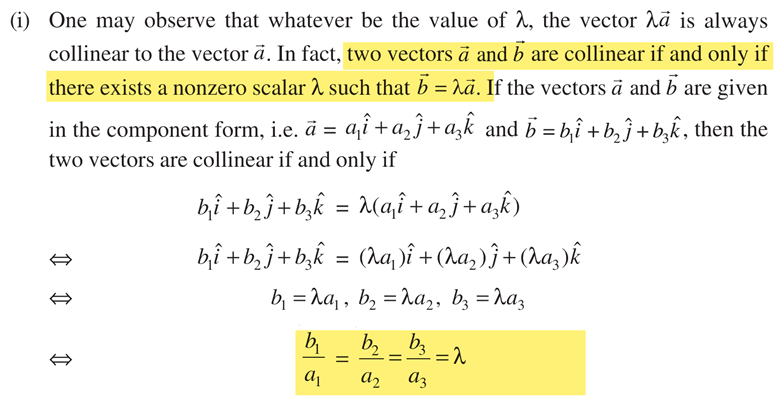
The question asks for the incorrect statements. Collinear vectors are parallel vectors: one is a scalar multiple of the other, \( \vec{b}=\lambda\vec{a} \) (with \( \vec{a}\ne\vec{0} \)). Writing this component by component gives
\( b_1=\lambda a_1,\ b_2=\lambda a_2,\ b_3=\lambda a_3 \)
The scalar \( \lambda \) can be any real number: for \( \lambda=2 \) the lengths differ, and for \( \lambda\lt 0 \) the directions are opposite.
So \( \vec{b}=\lambda\vec{a} \) with proportional components, where \( \lambda \) need not be \( \pm 1 \) and may be negative.
Checking the statements
(A) \( \vec{b}=\lambda\vec{a} \), for some scalar \( \lambda \) . — Correct. This is the definition of collinear vectors.
(B) Always \( \vec{a}=\pm\vec{b} \) . — Incorrect. \( \vec{b}=2\vec{a} \) is collinear with \( \vec{a} \), but \( \vec{a}\ne\pm\vec{b} \).
(C) the respective components of \( \vec{a} \) and \( \vec{b} \) are proportional. — Correct. \( b_1=\lambda a_1,\ b_2=\lambda a_2,\ b_3=\lambda a_3 \).
(D) both vectors \( \vec{a} \) and \( \vec{b} \) always have same direction. — Incorrect. \( \vec{b}=-\vec{a} \) is collinear with \( \vec{a} \) but points the opposite way.
The incorrect statements are (B) and (D).
NCERT (2026-27 edition):
Types of Vectors