
CUETMOCK
  • Pricing
  • Mentors
Log inStart freeStart free mocks→

First test, then trust

Try a free CUET mock test.

Join 5,00,000+ students who rehearsed exam day on the exact NTA screen before sitting CUET. On the web and on Android.

Start free mocks →Get the Android app
CUETMOCK

India's #1 CUET Mock Test Platform. Original NCERT-based questions on the exact NTA exam screen — trusted by 5,00,000+ students since CUET 2022.

Get it onGoogle PlayScan to download the CUETMOCK app

Mock tests

  • CUET mock test series
  • Browse all papers
  • Commerce mocks
  • Humanities (Arts) mocks
  • Science mocks
  • Languages & GAT mocks
  • Free practice questions
  • Pricing

Resources

  • CUET exam guide
  • CUET syllabus
  • Universities accepting CUET
  • Expert blogs
  • News & notifications
  • Webinars & counselling
  • CUET score calculator
  • How we estimate your rank
  • FAQs

Company

  • About us
  • Our leadership & team
  • Our toppers
  • Mentors
  • For schools
  • Contact us
  • Terms
  • Privacy
  • Refund policy

Talk to us

+91 7696 6630 56info@cuetmock.comWhatsApp us

Our other platforms

  • JEE Mock — For IIT-JEE aspirants
  • NEET Mock — For NEET aspirants

Newsletter

Exam updates, study material and offers — no spam.

© 2026 NYC Ventures Pvt. Ltd.

701-702, Royal Business Park, Zirakpur, Punjab - 140603

  • Terms of use
  • Privacy policy
  • Refund policy
  • Contact us

iCUETMOCK is an independent preparation platform, not affiliated with the National Testing Agency (NTA). Always check exam details on the official NTA website.

  • Home
  • Mock tests
  • CUET guide
  • Pricing
  • Log in
Home/Practice questions/Chemistry
ChemistryOrganic: Aldehydes, Ketones and Carboxylic Acids

Which of the following reagents can bring about the given conversion?…

Which of the following reagents can bring about the given conversion?

3-Nitrobromobenzene to 3-Nitrobenzoic acid.

Answer & explanation+

Correct answer: option 1

The correct answer is Option (1) → \(\text{(a) Mg-dry ether (b) }CO_2 \text{ (c) }H^+/H_2O\)

A –COOH group can be put in place of a halogen through a Grignard reagent. The aryl bromide reacts with magnesium in dry ether to give the Grignard reagent; this adds to carbon dioxide (dry ice) to give the salt of a carboxylic acid, which on acidification gives the acid:

    3-\( \ce{O2NC6H4Br} \) + Mg → 3-\( \ce{O2NC6H4MgBr} \) (dry ether)

    3-\( \ce{O2NC6H4MgBr} \) + \( \ce{CO2} \) → 3-\( \ce{O2NC6H4COOMgBr} \)

    3-\( \ce{O2NC6H4COOMgBr} \) + \( \ce{H3O^{+}} \) → 3-\( \ce{O2NC6H4COOH} \) (3-nitrobenzoic acid) + Mg(OH)Br

The carbon of \( \ce{CO2} \) becomes the carbon of the new –COOH group, so the sequence is Mg/ether, CO2, H3O+.

Why the other options are incorrect

  • Option (2) \(\text{(a) KCN (b) }H_3O^+\) — Incorrect. The C–Br bond of an aryl halide has partial double-bond character, so KCN does not replace the bromine; no nitrile is formed that acid could hydrolyse to –COOH.

  • Option (3) \(\text{(a) }KMnO_4 / OH^- \text{ (b) }H^+ / H_2O\) — Incorrect. Alkaline \( \ce{KMnO4} \) oxidises an alkyl side chain to –COOH; 3-nitrobromobenzene has no carbon side chain, so there is nothing to oxidise.

  • Option (4) \(\text{(a) }CrO_3/ H_2SO_4 \text{ followed by }H^+ /H_2O\) — Incorrect. Chromic acid also oxidises only a group that is already there (an alcohol or an alkyl side chain); it cannot put a new carbon atom in place of the bromine.

NCERT (2026-27 edition):
From Grignard Reagents
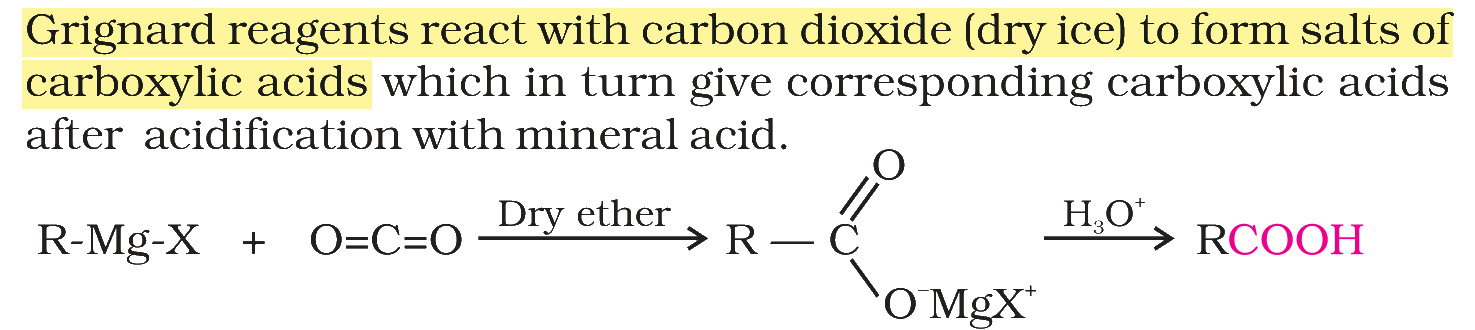
Textbook extract

Note: The same/similar question has been asked in different years by NTA as per the details given below:

20262025202420232022
–––09-06 S3
07-06 S3
31-05 S2
–

Advertisement

Practise more on Organic: Aldehydes, Ketones and Carboxylic Acids

Chapter-wise mocks on the real NTA exam screen, with solutions and your rank. Your first mocks are free.

Start free mocks →

Advertisement

Next questions

  1. The above passage talks about Khasi Tribe. Khasi tribe is_____.Sociology · Indian Society: Continuity and Change
  2. India's retail sector is attractive not only because of its fast growth, but because family run street corner stores have a large share of…Sociology · Social Change and Development in India: Change and Development in industrial Society
  3. Which one of the following is not a new source of threat?Political Science · Contemporary World Politics: Security in the Contemporary World
  4. In the given diagram, the circle stands for 'graduates'. the rectangle stands for 'school teachers'. and the triangle stands for 'married p…General Aptitude Test · Verbal Reasoning
  5. Who among the following is supposed to have belonged to the nishada category?History · Ancient India: Kinship, Caste and Class
  6. Assertion (A): A rise in a firm’s stock of unsold finished goods during a year is a part of investment.Reason (R): A firm’s stock of unsold…Economics · Macro Economics: Determination of Income and Employment
  7. Which of the following is a feature of business environment? A. Totality of external forcesB. Dynamic natureC. Inter-relatednessD. Assist i…Business Studies · Business Environment
  8. Among the population of India, the working - age people are relatively larger in number. What is the reason for this?Sociology · Indian Society: Demographic Structure of Indian Society
  9. At the time of dissolution of the firm, loss including deficiencies of capital is paid firstly out of:Accountancy Part A · Dissolution of Partnership Firm
  10. A clinical thermometer usually has a scale running from aboutGeneral Aptitude Test · General Knowledge