Which compound will exhibit the lowest boiling point?
Answer & explanation
Correct answer: option 4
The correct answer is Option (4) → N,N-dimethylethanamine
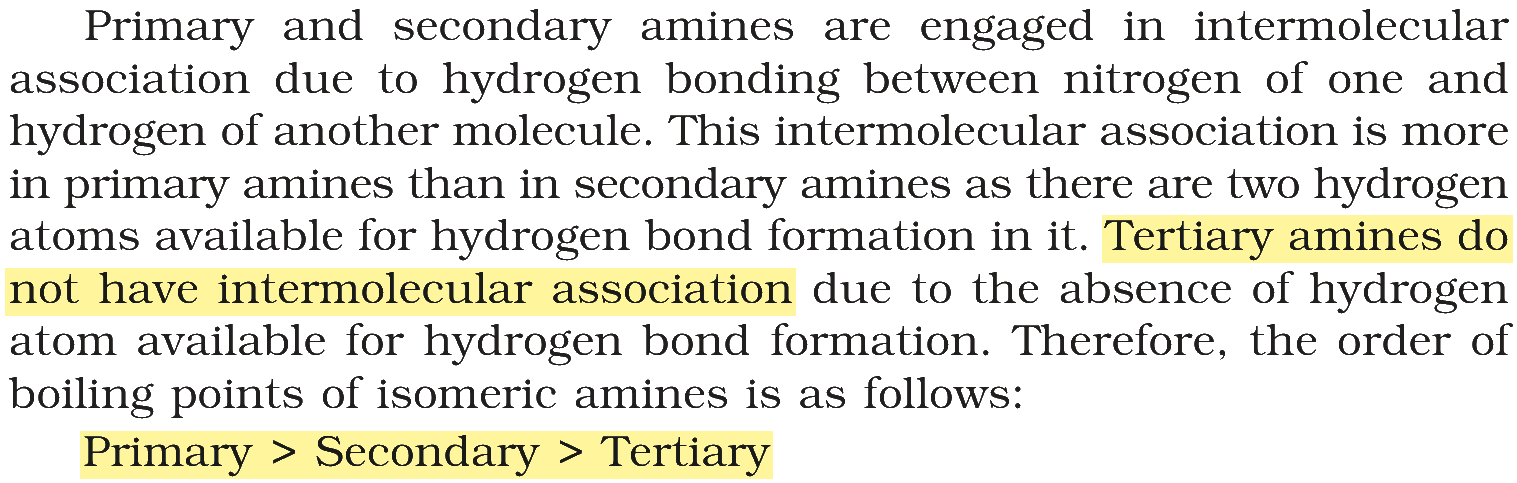
For compounds of nearly the same molar mass, the boiling point depends on how strongly the molecules hold one another, and the strongest force here is intermolecular hydrogen bonding. A molecule can take part in it only if it has a hydrogen on N or O. O–H bonds are more polar than N–H bonds, so alcohols form stronger hydrogen bonds than amines.
All four compounds have molar mass 73-74 g mol−1:
Butanol, \( \ce{C4H9OH} \): strong O–H hydrogen bonds; the highest boiling point.
Butanamine, \( \ce{C4H9NH2} \) (primary): two N–H hydrogens for hydrogen bonding.
Diethylamine, \( \ce{(C2H5)2NH} \) (secondary): only one N–H hydrogen, so less association.
N,N-dimethylethanamine, \( \ce{(CH3)2NC2H5} \) (tertiary): no hydrogen on nitrogen, so no intermolecular hydrogen bonding; the lowest boiling point.
\( \displaystyle \text{butanol} \gt \text{butanamine} \gt \text{diethylamine} \gt \text{N,N-dimethylethanamine} \)
So N,N-dimethylethanamine has the lowest boiling point.
Why the other options are incorrect
Option (1) Diethylamine — Incorrect. As a secondary amine it still has one N–H hydrogen and forms some hydrogen bonds, so it boils higher than the tertiary isomer.
Option (2) Butanol — Incorrect. The alcohol forms the strongest hydrogen bonds and has the highest boiling point of the four.
Option (3) Butanamine — Incorrect. The primary amine, with two N–H hydrogens, has the most hydrogen bonding among the amines.
NCERT (2026-27 edition):
Physical Properties – …