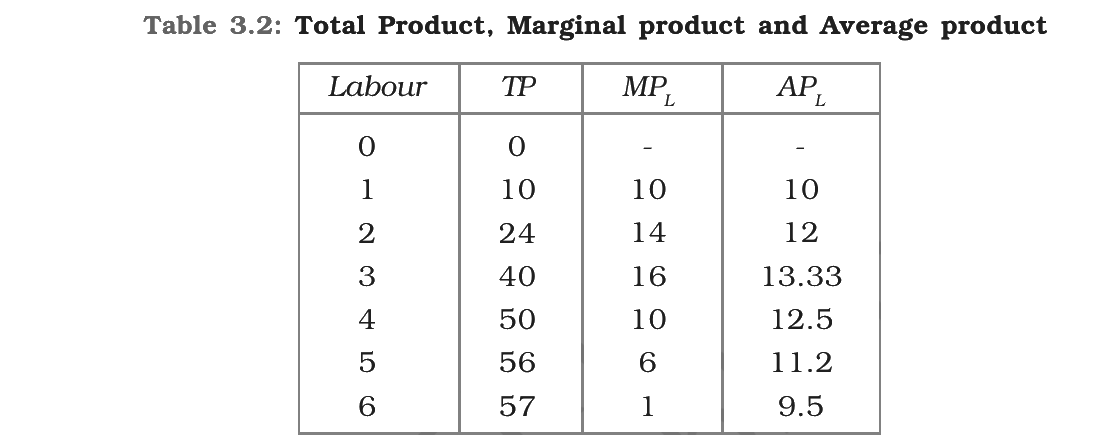
A farmer has a fixed area of land and keeps adding workers. Which chain of effects is correct?
Answer & explanation
Correct answer: option 4
The correct answer is Option (4) → Labour per unit of land rises → at first factor proportions become more suitable and MP rises → later the land gets crowded and MP falls, but TP keeps rising while MP is positive
Land is fixed, so adding workers changes the factor proportions. At first the mix becomes more suitable and MP rises. Later the land gets crowded and MP falls.
TP still rises as long as each extra worker adds something, that is, while MP is positive. For example, when MP falls to 1, TP still rises by 1 unit.
Option (1) Labour per unit of land rises → at first factor proportions become more suitable and MP rises → later the land gets crowded, MP falls and TP starts falling at once — Incorrect. A fall in MP does not make TP fall. TP keeps rising while MP is positive.
Option (2) Labour per unit of land rises → all inputs are scaled up together → output rises by a smaller proportion, showing decreasing returns to scale — Incorrect. Land is fixed, so all inputs are not scaled up. Returns to scale do not apply.
Option (3) Labour per unit of land rises → factor proportions stay the same → MP of each worker stays constant — Incorrect. Holding one factor fixed and adding the other changes the factor proportions.
Option (4) Labour per unit of land rises → at first factor proportions become more suitable and MP rises → later the land gets crowded and MP falls, but TP keeps rising while MP is positive — Correct. Each link holds.
NCERT (2026-27): “3.4 The Law of Diminishing Marginal Product and the Law of Variable Proportions … Why does this happen? In order to understand this, we first define the concept of factor proportions. Factor proportions represent the ratio in which the two inputs are combined to produce output. As we hold one factor fixed and keep increasing the other, the factor proportions change. Initially, as we increase the amount of the variable input, the factor proportions become more and more suitable for the production and marginal product increases. But after a certain level of employment, the production process becomes too crowded with the variable input.” “3.5 Shapes of Total Product, Marginal Product and Average Product Curves An increase in the amount of one of the inputs keeping all other inputs constant results in an increase in output. Table 3.2 shows how the total product changes as the amount of labour increases. The total product curve in the input-output plane is a positively sloped curve. Figure 3.1 shows the shape of the total product curve for a typical firm. …”
|