The question below is followed by two statements numbered I and II. Choose the option that describes whether the statements are sufficient to answer the question.
Five friends P, Q, R, S and T sit in a row of five seats, all facing north. Who sits at the extreme left end of the row?
I. R sits third to the right of P, and Q does not sit at either end of the row.
II. T sits immediately to the right of R, and S sits immediately to the left of Q.
Answer & explanation
Correct answer: option 3
The correct answer is Option (3) → The question can be answered by using both statements together, but not by using either statement alone.
Facing north, a person’s right is towards the east end of the row. Number the seats 1 to 5 from the left end; “third to the right of P” means three seats further right, with two persons between.
Statement I alone:
P and R are in seats 1 and 4, or in seats 2 and 5
In the second case seat 1 goes to S or T, since Q is not at an end
The person at the left end may be P, S or T: not sufficient
Statement II alone:
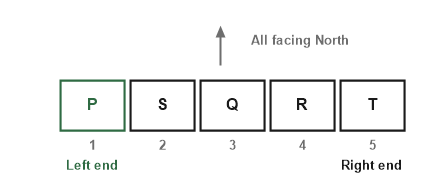
R, T stand together and S, Q stand together; for example P S Q R T and S Q R T P both fit
The person at the left end is not fixed: not sufficient
Both together:
T sits to the right of R, so R cannot be in seat 5; hence P is in seat 1 and R in seat 4
T is then in seat 5, and S, Q take seats 2 and 3 with S on the left: S in 2, Q in 3
The order is P S Q R T, and Q is not at an end, as I requires
P sits at the extreme left end: sufficient together