Identify the correct statements from the following :
(A) Deforestation means planting of more and more trees
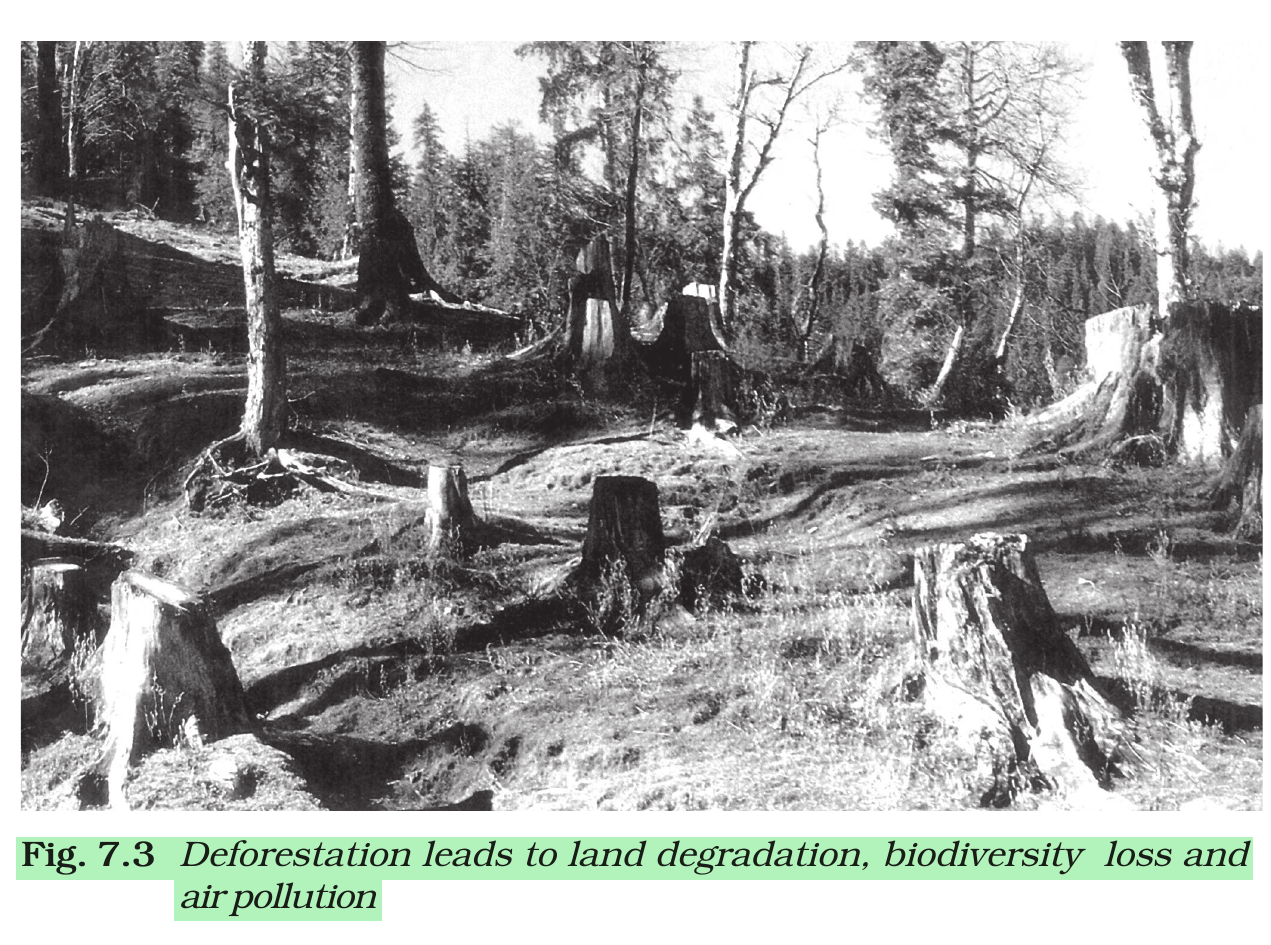
(B) Deforestation leads to biodiversity loss
(C) Deforestation contributes in the GDP of the country
(D) Deforestation leads to noise pollution
(E) Environment degradation is induced by poverty in India
Choose the correct answer from the options given below :
Answer & explanation
Correct answer: option 3
The correct answer is Option (3) → (B) and (E) only
(A) Deforestation means planting of more and more trees — Incorrect. Deforestation means cutting down forests and clearing the land. Planting trees is afforestation.
(B) Deforestation leads to biodiversity loss — Correct. Forests are home to many plants and animals. When forests are cleared, these species lose their habitat. So deforestation leads to biodiversity loss, along with land degradation and air pollution.
(C) Deforestation contributes in the GDP of the country — Incorrect. Deforestation uses up a natural resource. It degrades the land and lowers what the economy can produce in future. So it is a cost to the economy, not a contribution to it.
(D) Deforestation leads to noise pollution — Incorrect. Noise pollution is caused by loud sound, such as that of traffic and machines. The harms of deforestation are land degradation, biodiversity loss and air pollution.
(E) Environment degradation is induced by poverty in India — Correct. The threat to India’s environment has two sides. One is poverty-induced environmental degradation. The other is pollution from affluence and fast-growing industry.
NCERT (2026-27): “7.3 State of India’s Environment … The threat to India’s environment poses a dichotomy —threat of poverty-induced environmental degradation and, at the same time, threat of pollution from affluence and a rapidly growing industrial sector. Air pollution, water contamination, soil erosion, deforestation and wildlife extinction are some of the most pressing environmental concerns of India. The priority issues identified are (i) land degradation (ii) biodiversity loss (iii) air pollution with special reference to vehicular pollution in urban cities (iv) management of fresh water and (v) solid waste management.…”
|