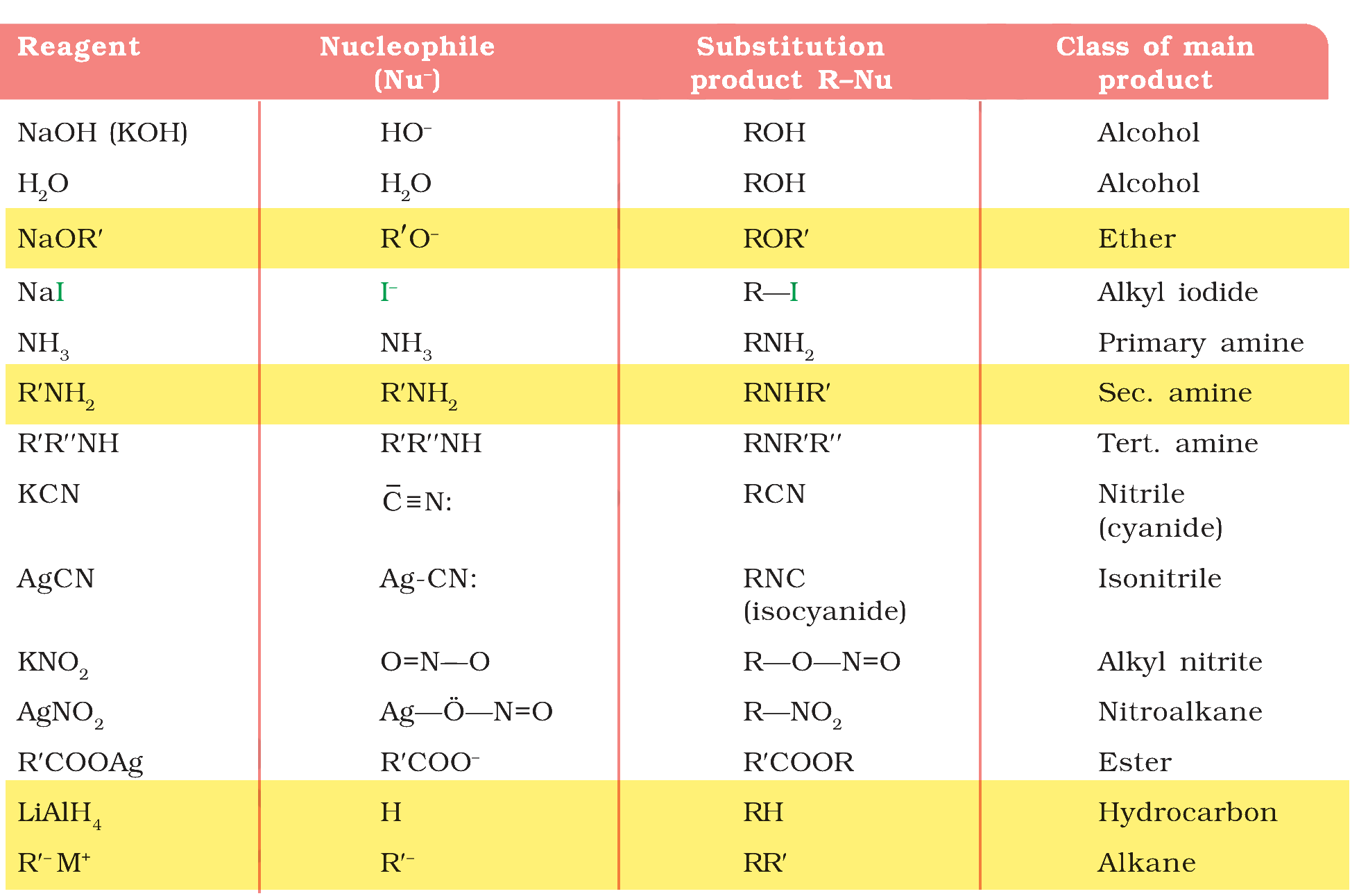
Consider the following statements about the main products formed when a haloalkane, R–X, reacts with some common reagents.
(A) A haloalkane, R–X, reacts with a primary amine, R′NH2, to give a secondary amine as the main product.
(B) A haloalkane, R–X, reacts with lithium aluminium hydride, LiAlH4, to give an alcohol as the main product.
(C) A haloalkane, R–X, reacts with a sodium alkoxide, NaOR′, to give an ester as the main product.
(D) A haloalkane, R–X, reacts with R′–M+ to give an alkane as the main product.
Which of the statements given above are correct? Choose the correct answer from the options given below:
Answer & explanation
Correct answer: option 2
The correct answer is Option (2) → (A) and (D) only
In nucleophilic substitution, the nucleophile takes the place of the halogen on the carbon atom, and the halogen leaves as a halide ion. The class of the main product depends on the atom or group that the nucleophile brings in:
\( \displaystyle \ce{R-X + Nu^- -> R-Nu + X^-} \)
(A) A haloalkane, R–X, reacts with a primary amine, R′NH2, to give a secondary amine as the main product. — True. The amine attaches through its nitrogen, so the product is RNHR′. Its nitrogen now carries two alkyl groups, which makes it a secondary amine.
(B) A haloalkane, R–X, reacts with lithium aluminium hydride, LiAlH4, to give an alcohol as the main product. — False. LiAlH4 supplies hydride (H) as the nucleophile, so the halogen is replaced by hydrogen. The product is the hydrocarbon RH, not an alcohol.
(C) A haloalkane, R–X, reacts with a sodium alkoxide, NaOR′, to give an ester as the main product. — False. The alkoxide ion R′O– links through its oxygen and gives ROR′, an ether. An ester, R′COOR, is formed with the carboxylate ion of R′COOAg.
(D) A haloalkane, R–X, reacts with R′–M+ to give an alkane as the main product. — True. The R′– group joins the carbon that carried the halogen, so a new carbon-carbon bond forms and the product RR′ is an alkane.
NCERT (2026-27 edition):
6.7.1 Reactions of Haloalkanes – “It is one of the most useful classes of organic reactions of alkyl halides in which halogen is bonded to sp3 hybridised carbon. The products formed by the reaction of haloalkanes with some common nucleophiles are given in Table 6.4.”
Table 6.4: Nucleophilic Substitution of Alkyl Halides (R–X)