
The figure shows a fuel cell in which hydrogen and oxygen are used to produce electricity.
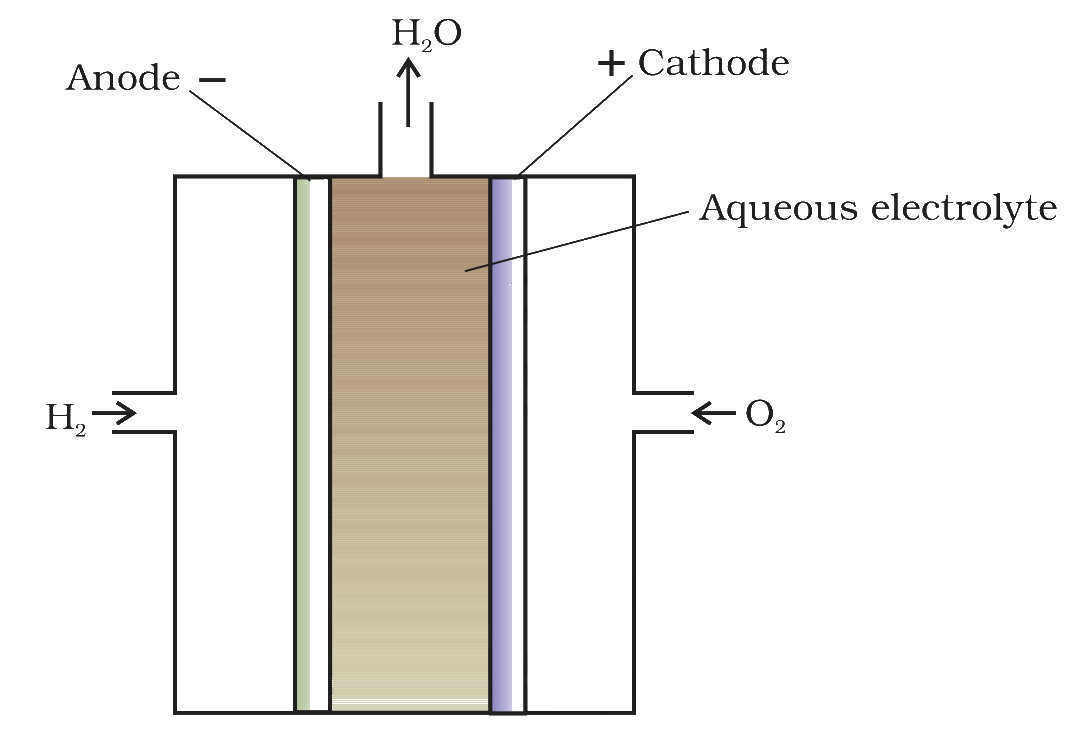
Consider the following statements about the working of this cell.
(A) The O2 entering from the right is reduced at the electrode on that side, and OH− ions are formed.
(B) At the electrode on the side where H2 enters, hydrogen is oxidised and OH− ions are used up.
(C) The H2O leaving through the outlet at the top is formed at the electrode on the side where O2 enters.
(D) The sodium hydroxide of the aqueous electrolyte is used up in the cell reaction, so the cell stops once it is exhausted.
Which of the statements given above are correct? Choose the correct answer from the options given below:
Answer & explanation
Correct answer: option 1
The correct answer is Option (1) → (A) and (B) only
In this fuel cell, hydrogen and oxygen are bubbled through porous carbon electrodes into concentrated aqueous sodium hydroxide. Each gas reacts at the electrode it is fed to: oxygen is reduced on one side and hydrogen is oxidised on the other.
Cathode (O2 side): \( \ce{O2(g) + 2H2O(l) + 4e^- -> 4OH^-(aq)} \)
Anode (H2 side): \( \ce{2H2(g) + 4OH^-(aq) -> 4H2O(l) + 4e^-} \)
Cell reaction: \( \ce{2H2(g) + O2(g) -> 2H2O(l)} \)
(A) The O2 entering from the right is reduced at the electrode on that side, and OH− ions are formed. — True. The electrode on the O2 side is the cathode. Oxygen takes up electrons there and gives 4OH− ions.
(B) At the electrode on the side where H2 enters, hydrogen is oxidised and OH− ions are used up. — True. At the anode, H2 reacts with 4OH− ions and gives up 4 electrons. The OH− ions formed at the cathode are used up here.
(C) The H2O leaving through the outlet at the top is formed at the electrode on the side where O2 enters. — False. Water is formed at the electrode on the H2 side (4H2O in the anode reaction). At the O2 side water is used up (2H2O in the cathode reaction), not formed.
(D) The sodium hydroxide of the aqueous electrolyte is used up in the cell reaction, so the cell stops once it is exhausted. — False. The OH− ions used up at the anode are formed again at the cathode, so the sodium hydroxide is not consumed. The cell reaction is only 2H2 + O2 → 2H2O. The cell runs continuously as long as the reactants (H2 and O2) are supplied.
NCERT (2026-27 edition):
2.7 Fuel Cells – “One of the most successful fuel cells uses the reaction of hydrogen with oxygen to form water (Fig. 2.12). …In the cell, hydrogen and oxygen are bubbled through porous carbon electrodes into concentrated aqueous sodium hydroxide solution. Catalysts like finely divided platinum or palladium metal are incorporated into the electrodes for increasing the rate of electrode reactions. The electrode reactions are given below:”
Cathode: O2(g) + 2H2O(l) + 4e– → 4OH–(aq)
Anode: 2H2(g) + 4OH–(aq) → 4H2O(l) + 4e–
“…2H2(g) + O2(g) → 2H2O(l). The cell runs continuously as long as the reactants are supplied.”
Fig. 2.12: Fuel cell using H2 and O2 produces electricity.