CUETMOCK
  • Pricing
  • Mentors
Log inStart freeStart free mocks→

First test, then trust

Try a free CUET mock test.

Join 5,00,000+ students who rehearsed exam day on the exact NTA screen before sitting CUET. On the web and on Android.

Start free mocks →Get the Android app
CUETMOCK

India's #1 CUET Mock Test Platform. Original NCERT-based questions on the exact NTA exam screen — trusted by 5,00,000+ students since CUET 2022.

Get it onGoogle PlayScan to download the CUETMOCK app

Mock tests

  • CUET mock test series
  • Browse all papers
  • Commerce mocks
  • Humanities (Arts) mocks
  • Science mocks
  • Languages & GAT mocks
  • Free practice questions
  • Pricing

Resources

  • CUET exam guide
  • CUET syllabus
  • Universities accepting CUET
  • Expert blogs
  • News & notifications
  • Webinars & counselling
  • CUET score calculator
  • How we estimate your rank
  • FAQs

Company

  • About us
  • Our leadership & team
  • Our toppers
  • Mentors
  • For schools
  • Contact us
  • Terms
  • Privacy
  • Refund policy

Talk to us

+91 7696 6630 56info@cuetmock.comWhatsApp us

Our other platforms

  • JEE Mock — For IIT-JEE aspirants
  • NEET Mock — For NEET aspirants

Newsletter

Exam updates, study material and offers — no spam.

© 2026 NYC Ventures Pvt. Ltd.

701-702, Royal Business Park, Zirakpur, Punjab - 140603

  • Terms of use
  • Privacy policy
  • Refund policy
  • Contact us

iCUETMOCK is an independent preparation platform, not affiliated with the National Testing Agency (NTA). Always check exam details on the official NTA website.

  • Home
  • Mock tests
  • CUET guide
  • Pricing
  • Log in
Home/Practice questions/Accountancy Part A
Accountancy Part AIssue and Redemption of Debentures

A Ltd. issued a ₹100, 7% debenture at a discount of 5% redeemable at…

A Ltd. issued a ₹100, 7% debenture at a discount of 5% redeemable at 10% premium after 3 years. Choose the amount to be shown as loss on issue of debenture account.

Answer & explanation+

Correct answer: option 3

The correct answer is Option (3) → ₹15

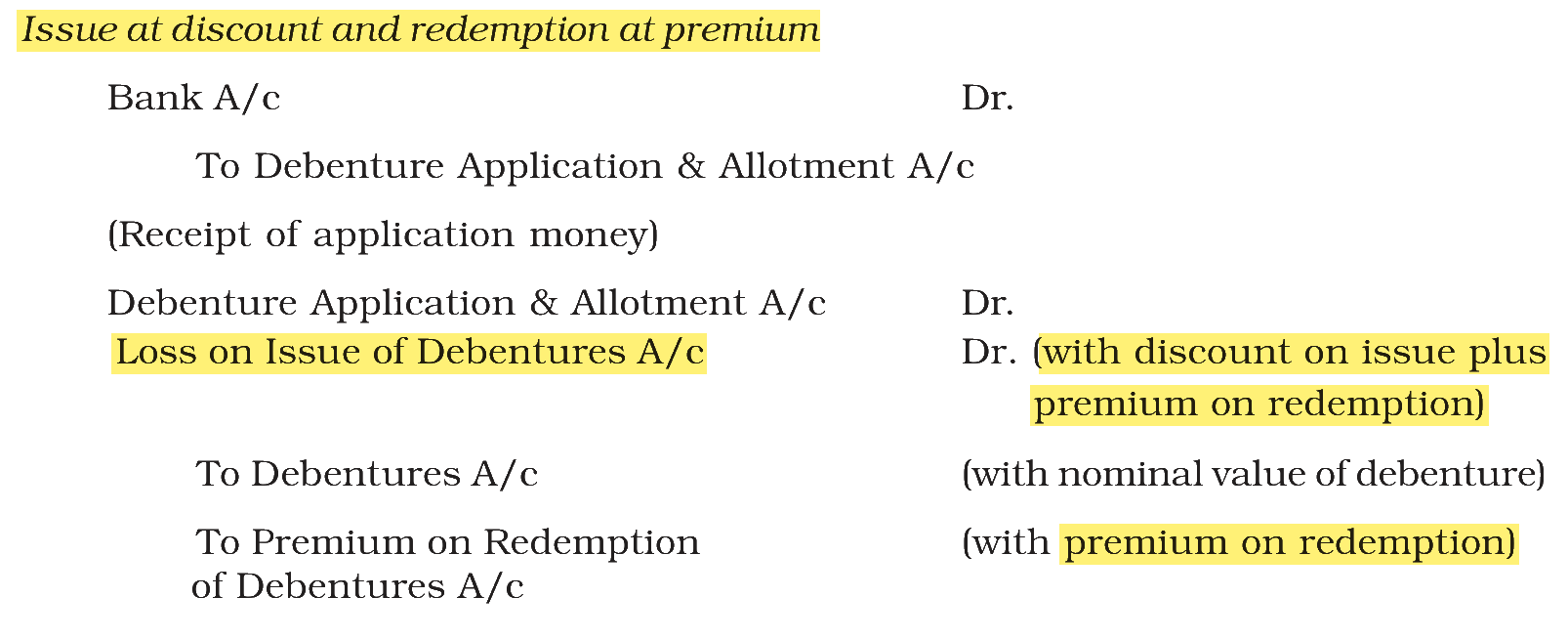
When debentures are issued at a discount and are redeemable at a premium, Loss on Issue of Debentures is debited with discount on issue plus premium on redemption.

Discount on issue = 5% of ₹100 = ₹5

Premium on redemption = 10% of ₹100 = ₹10

Loss on issue of debenture = ₹5 + ₹10 = ₹15

NCERT (2026-27 edition):
Exercises – “… 18. B. Ltd. issued 1,000, 12% debentures of Rs. 100 each on April 01, 2014 at a discount of 5% redeemable at a premium of 10%.”

NCERT (2026-27 edition):
Terms of Issue of Debentures

Extract from the NCERT textbook

Advertisement

Practise more on Issue and Redemption of Debentures

Chapter-wise mocks on the real NTA exam screen, with solutions and your rank. Your first mocks are free.

Start free mocks →

Advertisement

Next questions

  1. What was the fear of the 'environmentalists' regarding the setting up of industries in Orissa?Political Science · Politics in India Since Independence: Politics of Planned Development
  2. Let f(x)=a-(x-3)^8 / 9, then greatest value of f(x) isMaths. Section B1 · Applications of Derivatives
  3. Identify the amount realised in cash from sundry debtors.Accountancy Part A · Dissolution of Partnership Firm
  4. A and B are mutually exclusive events with P(A)=1/4 and P(B)=2/5 . What is the probability that A or B occurs?General Aptitude Test · Quantitative Reasoning
  5. Chemistry · Inorganic: Coordination Compounds
  6. What is the meaning of the idiom "To eat one’s own words"?English · Grammar: Idioms
  7. ‘Specialised drills’ have not been found at which location?History · Ancient India: Bricks, Beads and Bones
  8. If x^4+x^2 y^2+y^4=21 and x^2+x y+y^2=7, then the value of ≤ft(1/(x^2)+1/(y^2)) is:General Aptitude Test · Quantitative Reasoning
  9. Choose the alternative that best suits as a question tag for the following sentence : Don't pick the flowers __________.English · Grammar: Question Tags
  10. In March 2020, the RBI reduced the Cash Reserve Ratio (CRR) of all banks from 4 per cent to 3 per cent. What was the aim of this move?Economics · Macro Economics: Money and Banking