Which of the following represents the correct order of densities?
Answer & explanation
Correct answer: option 2
The correct answer is Option (2) → \(CCl_4 > CHCl_3 > CH_2Cl_2 > H_2O > CH_3Cl\)
In the chloromethanes the density rises with the number of chlorine atoms. Polychloro compounds are heavier than water (1.00 g/mL); chloromethane, with a single chlorine atom, is not.
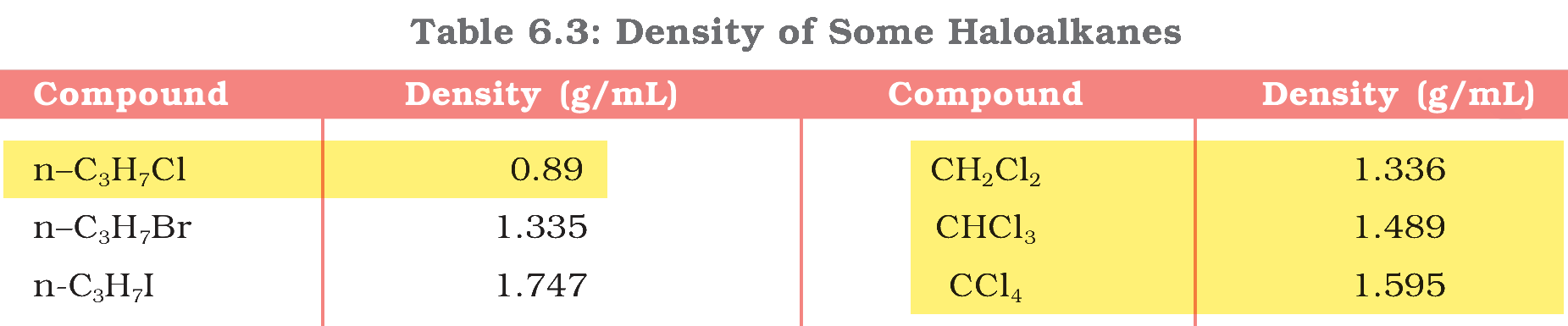
\( \ce{CCl4} \) — first: four Cl atoms, density 1.595 g/mL.
\( \ce{CHCl3} \) — second: three Cl atoms, 1.489 g/mL.
\( \ce{CH2Cl2} \) — third: two Cl atoms, 1.336 g/mL, still a polychloro compound and so denser than water.
\( \ce{H2O} \) — fourth: 1.00 g/mL.
\( \ce{CH3Cl} \) — last: only one Cl atom, so it is not a polychloro derivative; like the monochloro compound n-C3H7Cl (0.89 g/mL), it is lighter than water.
NCERT (2026-27 edition):
6.6 Physical Properties – “Density
Bromo, iodo and polychloro derivatives of hydrocarbons are heavier than water. The density increases with increase in number of carbon atoms, halogen atoms and atomic mass of the halogen atoms (Table 6.3).”