Arrange the following statements occuring in India in the proper sequence:
(A) Parliament passes Mahatma Gandhi National Rural Employment Guarantee Act (MNREGA)
(B) Setting up of NABARD
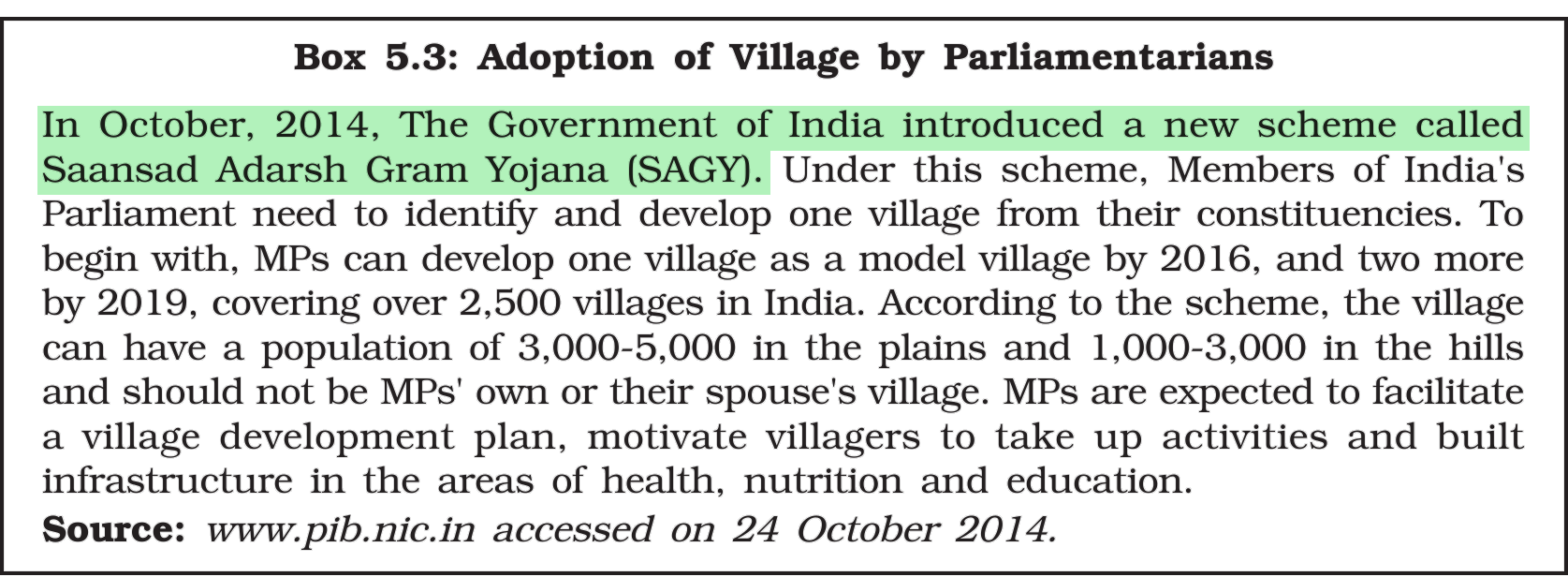
(C) Saansad Adarsh Gram Yojana (SAGY) launched
(D) Initiation of Food for Work Programme
Choose the correct answer from the options given below :
Answer & explanation
Correct answer: option 1
The correct answer is Option (1) → (D), (B), (A), (C)
(D) Initiation of Food for Work Programme — started in the 1970s.
(B) Setting up of NABARD — set up in 1982 as the apex body for rural credit.
(A) Parliament passes Mahatma Gandhi National Rural Employment Guarantee Act (MNREGA) — the Act was passed in 2005.
(C) Saansad Adarsh Gram Yojana (SAGY) launched — introduced in October 2014. Under it, each Member of Parliament develops a village of the constituency as a model village.
Note: The Food for Work Programme was in the chapter ‘Poverty’ which was there in the pre-rationalised NCERT and has been deleted from subsequent editions of NCERT, including the NCERT book (2026-27).
NCERT (2026-27): “5.3 Credit and Marketing in Rural Areas … A major change occurred after 1969 when India adopted social banking and multi-agency approach to adequately meet the needs of rural credit. Later, the National Bank for Agriculture and Rural Development (NABARD) was set up in 1982 as an apex body to coordinate the activities of all institutions involved in the rural financing system.…” NCERT (2026-27), chapter ‘Employment: Growth, Informalisation and Other Issues’: “6.9 Government and Employment Generation … You may recall about the Mahatma Gandhi National Rural Employment Guarantee Act 2005. It promises 100 days of guaranteed wage employment to all rural households who volunteer to do unskilled manual work.…”
NCERT (Pre-rationalised), chapter ‘Poverty’: “…While looking for alternatives to specifically address the poor, policy makers started thinking that incomes and employment for the poor could be raised through the creation of additional assets and by means of work generation. This could be achieved through specific poverty alleviation programmes. This second approach has been initiated from the Third Five Year Plan (1961-66) and progressively enlarged since then. One of the noted programmes initiated in the 1970s was Food for Work.…” |