Read the passage and answer the following questions given:
The Indian nation-state is socially and culturally one of the most diverse countries of the world. It has a population of about 1.21 billion people, according to Census of India 2011 (Provisional), currently the second largest- and soon to become the largest- national population in the world. These billion-plus people speak about 1,632 different languages and dialects. As many as eighteen of these languages have been officially recognised and placed under the 8th Schedule of the Constitution, thus guaranteeing their legal status. In terms of religion, about 80.5% of the population are Hindus, who in turn are regionally specific, plural in beliefs and practices, and divided by castes and languages. About 13.4% of the population are Muslims, which makes India the world's third largest Muslim country after Indonesia and Pakistan. The other major religious communities are Christians (2.3%), Sikhs (1.9%), Buddhists (0.8%) and Jains (0.4%). Because of India's huge population, these small percentages can also add up to large absolute numbers.)
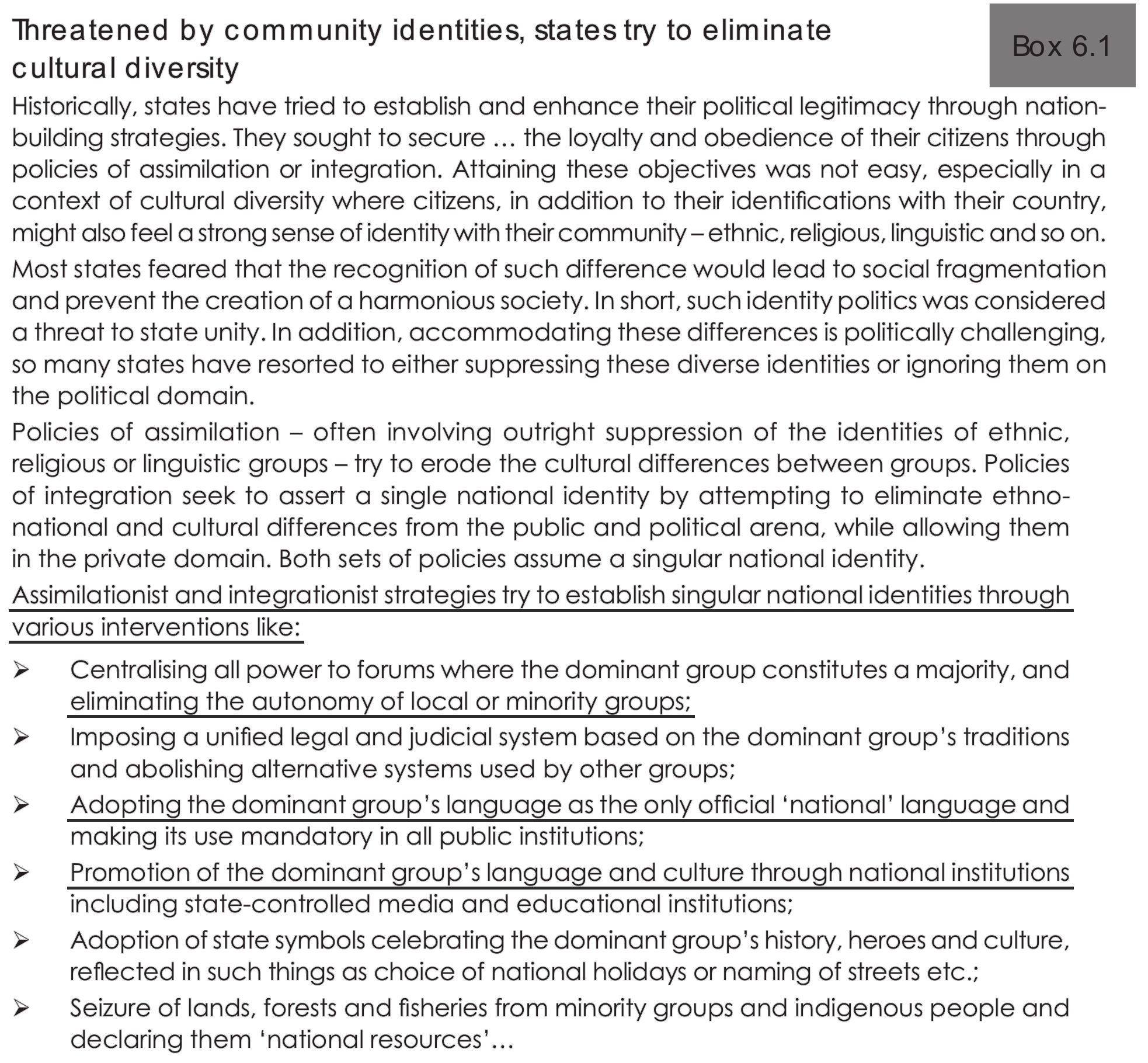
Assimilationist & integrationist strategies try to establish singular national identities.
Which of the following is not such a strategy?
Answer & explanation
Correct answer: option 3
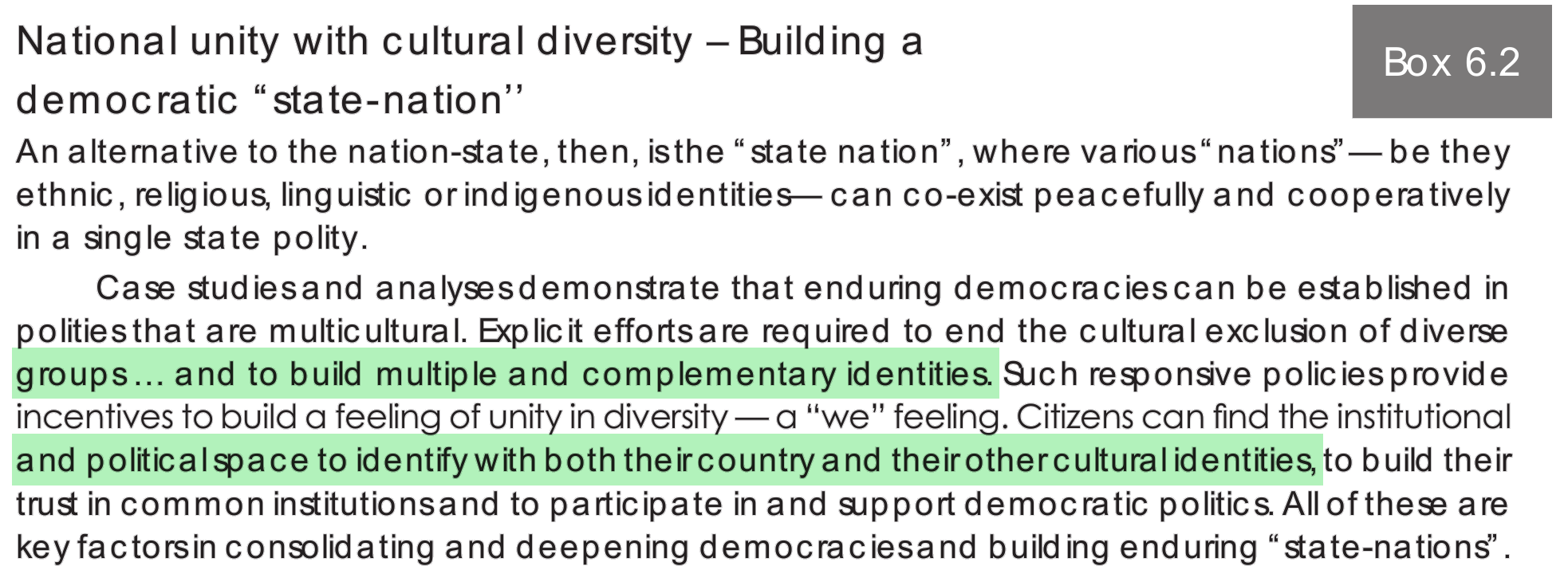
The correct answer is Option (3) → Building multiple & complementary identities.
Option (1) Eliminating the autonomy of local or minority groups — Such a strategy (Incorrect). Assimilationist and integrationist states try to establish a singular national identity by centralising all power in forums where the dominant group is the majority and eliminating the autonomy of local or minority groups.
Option (2) Adopting dominant group's language as the only official national language. — Such a strategy (Incorrect). Making the dominant group’s language the only official ‘national’ language, and its use compulsory in all public institutions, pushes the other languages out of public life. It is one of the interventions these strategies use.
Option (3) Building multiple & complementary identities. — Not such a strategy (Correct). Building multiple and complementary identities belongs to the opposite approach, the “state-nation”. Instead of one singular identity, citizens can identify with both their country and their other cultural identities, which builds a feeling of unity in diversity.
Option (4) Promoting dominant group's language & culture. — Such a strategy (Incorrect). Promoting the dominant group’s language and culture through national institutions, such as state-controlled media and educational institutions, is another intervention of assimilationist and integrationist states.
NCERT: Indian Society — Chapter 6: The Challenges of Cultural Diversity, Boxes 6.1 and 6.2 (2025-26)
|