Consider the following wavelengths of electromagnetic radiation:
(A) 3 cm
(B) \( 20\,\mu\mathrm{m} \)
(C) 550 nm
(D) \( 1.5\,\mu\mathrm{m} \)
(E) 300 nm
(F) 0.2 mm
How many of the above wavelengths lie in the infrared region of the electromagnetic spectrum?
Answer & explanation
Correct answer: option 3
The correct answer is Option (3) → 3
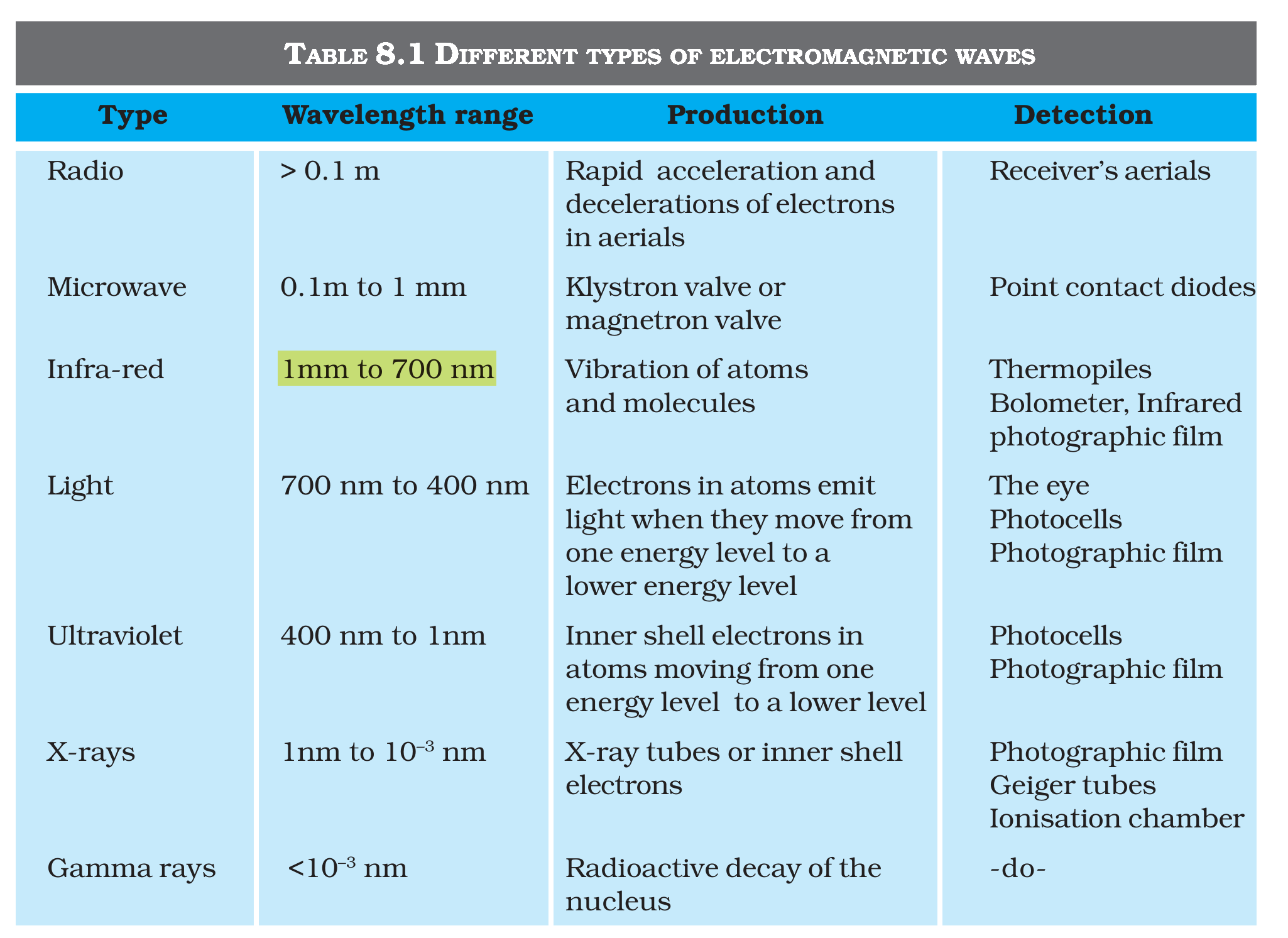
The infrared band covers wavelengths from about 1 mm down to 700 nm. It sits between the microwaves on the long side and visible light on the short side.
Wavelengths in the infrared region:
(B) \( 20\,\mu\mathrm{m} \) — equal to 20,000 nm, well inside 1 mm to 700 nm.
(D) \( 1.5\,\mu\mathrm{m} \) — equal to 1500 nm, just beyond the red end of the visible band.
(F) 0.2 mm — shorter than 1 mm, so it lies at the long-wavelength end of the infrared band.
Wavelengths outside it:
(A) 3 cm — between 0.1 m and 1 mm, a microwave.
(C) 550 nm — between 700 nm and 400 nm, visible light.
(E) 300 nm — between 400 nm and 1 nm, ultraviolet.
Total: 3 wavelengths lie in the infrared region.
NCERT (2026-27):
Electromagnetic Spectrum