
The figure shows the electric field lines for four charge configurations (a), (b), (c) and (d).
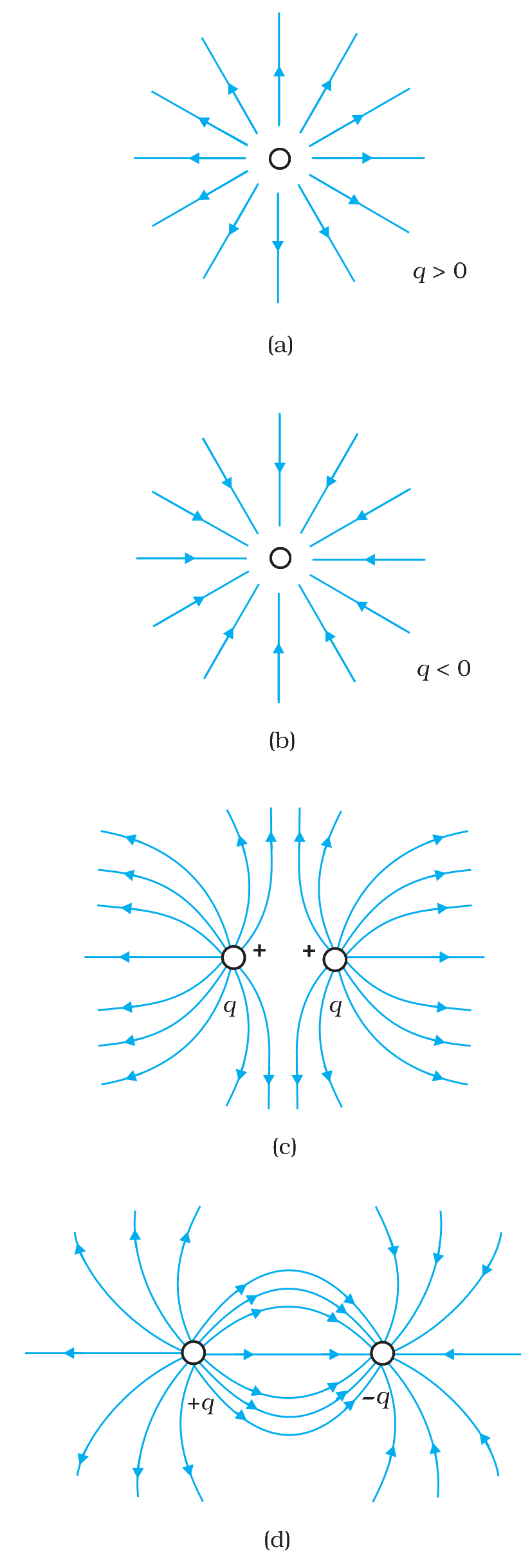
Which of the following statements about these field lines is correct?
Answer & explanation
Correct answer: option 3
The correct answer is Option (3) → In (c), the field lines show that the two charges repel each other.
Field lines start from positive charges and end at negative charges. They crowd together where the field is strong.
Option (1) In (d), the field lines start on \(-q\) and end on \(+q\). — Incorrect. The lines leave \( +q \) and end on \( -q \). The arrows in (d) point from the positive charge towards the negative one.
Option (2) In (d), the electric field is zero at the point midway between the charges. — Incorrect. Midway between \( +q \) and \( -q \), the fields of both charges point towards \( -q \). So they add. The field lines are crowded there, which shows a strong field.
Option (3) In (c), the field lines show that the two charges repel each other. — Correct. Both charges in (c) are positive. Their lines turn away from each other and leave the region between them empty. This is the picture of mutual repulsion.
Option (4) In (a) and (b), the field lines get closer together farther from the charge. — Incorrect. The radial lines spread apart as we move away from the charge. This shows that the field becomes weaker with distance.
NCERT (2026-27):
Electric Field Lines – “… The field lines of a single positive charge are radially outward while those of a single negative charge are radially inward. The field lines around a system of two positive charges (q, q) give a vivid pictorial description of their mutual repulsion, while those around the configuration of two equal and opposite charges (q, –q), a dipole, show clearly the mutual attraction between the charges. …”
FIGURE 1.14 Field lines due to some simple charge configurations.