
If A and B are two disjoint events then
A. \(A\cap B=\Phi\)
B. \(P(A\cap B)=0\)
C. \(P(A\cup B)=P(A)+P(B)\)
D. \(P(A\cap B)=1\)
Choose the correct answer from the options given below:
Answer & explanation
Correct answer: option 3
The correct answer is Option (3) → A, B, C only
Two events are disjoint (mutually exclusive) when they have no outcome in common, so they cannot happen together.
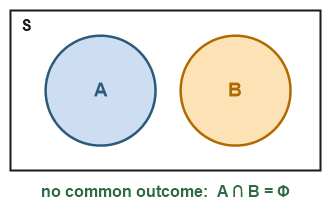
A. \(A\cap B=\Phi\) Correct. With no common outcome, the intersection of A and B is the empty set.
B. \(P(A\cap B)=0\) Correct. The empty set contains no outcome, so it is an impossible event with probability 0.
C. \(P(A\cup B)=P(A)+P(B)\) Correct. The addition rule is \(P(A\cup B)=P(A)+P(B)-P(A\cap B)\), and for disjoint events the last term is 0.
D. \(P(A\cap B)=1\) Incorrect. A probability of 1 belongs to a sure event; A and B can never happen together, so the probability is 0, not 1.