
CUETMOCK
  • Pricing
  • Mentors
Log inStart freeStart free mocks→

First test, then trust

Try a free CUET mock test.

Join 5,00,000+ students who rehearsed exam day on the exact NTA screen before sitting CUET. On the web and on Android.

Start free mocks →Get the Android app
CUETMOCK

India's #1 CUET Mock Test Platform. Original NCERT-based questions on the exact NTA exam screen — trusted by 5,00,000+ students since CUET 2022.

Get it onGoogle PlayScan to download the CUETMOCK app

Mock tests

  • CUET mock test series
  • Commerce mocks
  • Humanities (Arts) mocks
  • Science mocks
  • Languages & GAT mocks
  • Free practice questions
  • Pricing

Resources

  • CUET exam guide
  • CUET syllabus
  • Universities accepting CUET
  • Expert blogs
  • News & notifications
  • Webinars & counselling
  • CUET score calculator
  • How we estimate your rank
  • FAQs

Company

  • About us
  • Our leadership & team
  • Our toppers
  • Mentors
  • For schools
  • Contact us
  • Terms
  • Privacy
  • Refund policy

Talk to us

+91 7696 6630 56info@cuetmock.comWhatsApp us

Our other platforms

  • JEE Mock — For IIT-JEE aspirants
  • NEET Mock — For NEET aspirants

Newsletter

Exam updates, study material and offers — no spam.

© 2026 NYC Ventures Pvt. Ltd.

701-702, Royal Business Park, Zirakpur, Punjab - 140603

  • Terms of use
  • Privacy policy
  • Refund policy
  • Contact us

iCUETMOCK is an independent preparation platform, not affiliated with the National Testing Agency (NTA). Always check exam details on the official NTA website.

  • Home
  • Mock tests
  • CUET guide
  • Pricing
  • Log in
Home/Practice questions/Chemistry
ChemistryOrganic: Aldehydes, Ketones and Carboxylic Acids

The product (X) is:

Answer the question on basis of passage given below:

Organic compounds containing carbon-oxygen double bonds (C=O) are called carbonyl compounds. These are highly polar molecules. Hence, their boiling points are higher than hydrocarbons and ethers. Aldehydes can be prepared from dehydrogenation or oxidation of alcohols and by reduction of acyl halides. Ketones are prepared by oxidation of secondary alcohols or by hydration of alkynes etc. Aldehydes and ketones undergo nucleophilic addition reaction with a number of nucleophiles such as HCN, NaHSO3, ammonia derivatives. Carboxylic acids are prepared by the oxidation of primary alcohols, aldehydes and alkenes, by hydrolysis of nitriles. Carboxylic acids are more acidic than alcohols and phenols.

The product (X) is:

Figure for Q6

Answer & explanation+

Correct answer: option 4

The correct answer is Option (4) → R–CH=CH–CH=N–NH–CO–NH2

Aldehydes and ketones react with ammonia derivatives H2N–Z in weakly acidic medium by nucleophilic addition followed by loss of water; the C=O becomes C=N–Z. With semicarbazide (Z = \( \ce{NHCONH2} \)) the product is a semicarbazone.

Semicarbazide, \( \ce{H2N-NH-CO-NH2} \), has two \( \ce{NH2} \) groups, but only the one at the hydrazine end is nucleophilic; the lone pair of the other \( \ce{NH2} \) is delocalised onto the C=O (amide resonance). So the free \( \ce{NH2} \) of the hydrazine end attacks the CHO carbon, and the C=C double bond of the aldehyde is not touched:

    R–CH=CH–CHO + \( \ce{H2N-NH-CO-NH2} \) → \( \ce{R-CH=CH-CH=N-NH-CO-NH2} \) + \( \ce{H2O} \)

This is the structure in Option (4).

Why the other options are incorrect

  • Option (1) — Incorrect. It joins the aldehyde carbon to a carbon (\( \ce{C=C(NH2)-NH-NH2} \)); the C=O of semicarbazide has disappeared and no C=N bond is formed, which is not what a condensation with an ammonia derivative gives.

  • Option (2) — Incorrect. Here the aldehyde carbon is bonded to the amide nitrogen (\( \ce{CH=N-CO-NH-NH2} \)); that nitrogen is not nucleophilic because its lone pair is delocalised onto the C=O, so it does not react.

  • Option (3) — Incorrect. It shows the C=C converted into \( \ce{CH2-CO} \), a change of the carbon chain that this reaction does not bring about; only the CHO group reacts.

NCERT (2026-27 edition):
Reaction with Ammonia and Its Derivatives – …
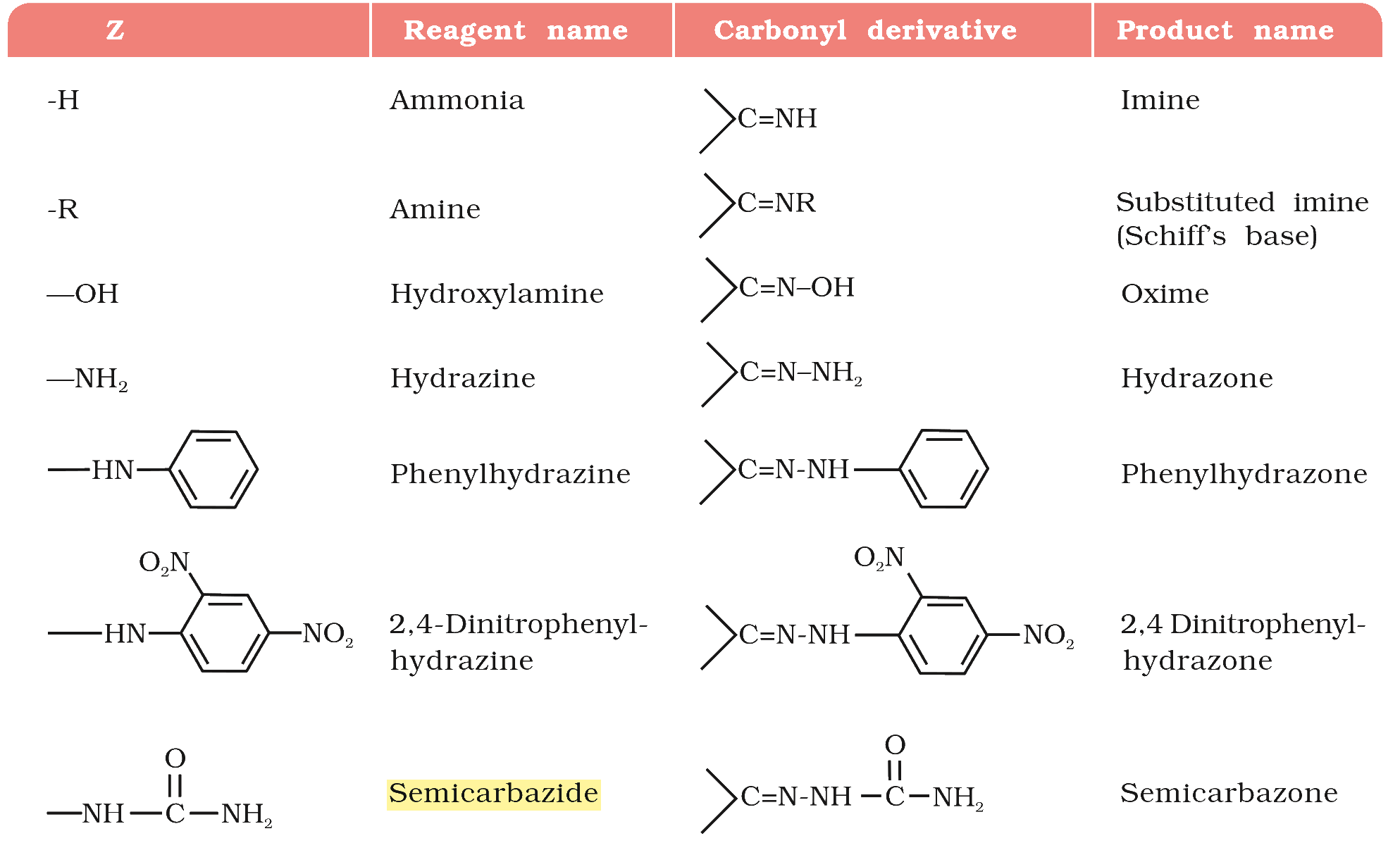
Textbook extract

Note: The same/similar question has been asked in different years by NTA as per the details given below:

20262025202420232022
–––09-06 S3
07-06 S3
–

Advertisement

Practise more on Organic: Aldehydes, Ketones and Carboxylic Acids

Chapter-wise mocks on the real NTA exam screen, with solutions and your rank. Your first mocks are free.

Start free mocks →

Advertisement

Next questions

  1. Select the letter-cluster from among the given options that can replace the question mark (?) in the following series. ORGANS, SORGAN, SNOR…General Aptitude Test · General Ability
  2. Find the mean proportion of 1/4 and 1/9 .General Aptitude Test · Numerical Ability
  3. Who is the author of the book "Fantastic Beasts: The Secrets Of Dumbledore"?General Aptitude Test · Current Affairs
  4. Assertion: Biogas is a mixture of gases (containing predominantly methane) produced by the microbial activity and which may be used as fuel…Biology · Microbes in Human Welfare
  5. The writer found looking after the baby animalsEnglish · Comprehension - (Narrative / Factual)
  6. Select the most appropriate option to fill in the blank. Have you ______ for a job in this company?English · Fill Blanks
  7. Two bodies of masses 4 kg and 5 kg are acted upon by the same force. If the acceleration of lighter body is 2 m/s², the acceleration of hea…Physics · Laws of Motion
  8. An uncharged metal slab and a dielectric slab of dielectric constant 4 are placed in the same uniform external electric field E_0 . The fac…Physics · Electrostatic Potential and Capacitance
  9. In a code language “YHJR” was coded as “ZGKQ” and “IOLS” was coded as “JNMR”. What is the code for “HOLE”?General Aptitude Test · Verbal Reasoning
  10. What is ABC analysis in the Rational Emotive Therapy?Psychology · Therapeutic Approaches