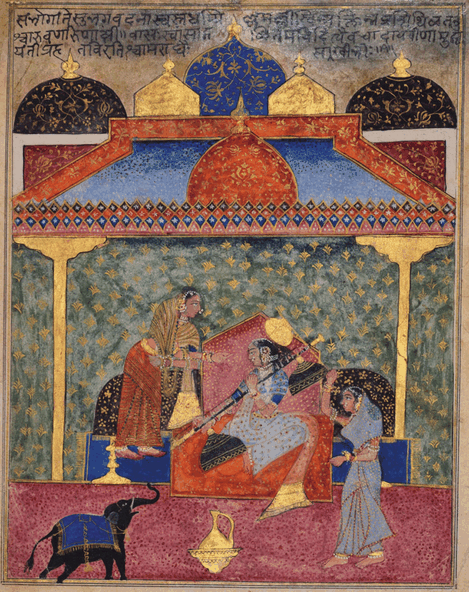
A small dark elephant is seen in Ragini Pathamsika of Raga Hindola. Besides creating visual interest, what does the elephant do in the composition?
Answer & explanation
Correct answer: option 1
The correct answer is Option (1) → It breaks the architectonic structuring
Option (1) It breaks the architectonic structuring — Correct. Small in scale, the elephant creates visual interest and breaks the architectonic structuring.
Option (2) It balances the red with green — Incorrect. This belongs to the colour scheme: red is dominant and is complimented by green. It is not given as the elephant’s role.
Option (3) It deepens the dark outlines of the forms — Incorrect. Nearly all forms are emphasised with dark line. This is the style of the whole painting, as at Ajanta, not the elephant’s role.
Option (4) It frames the letters on the domes — Incorrect. The letters in Devanagari script fill the two domes in the upper part. The elephant sits in the left hand corner.
NCERT (2026-27): “Ragini Pathamsika of Raga Hindola …The colours are vibrant. Red is dominant and is complimented by green. …Nearly all forms are deeply emphasied with dark line. This is interestingly observable in the mural paintings of Ajanta, too, which were painted centuries ago. What is also to be noted here is a dark elephant in the left hand corner, with a raised trunk, a delightful sign of welcome. Small in scale, the elephant creates visual interest and breaks the architectonic structuring.”
|