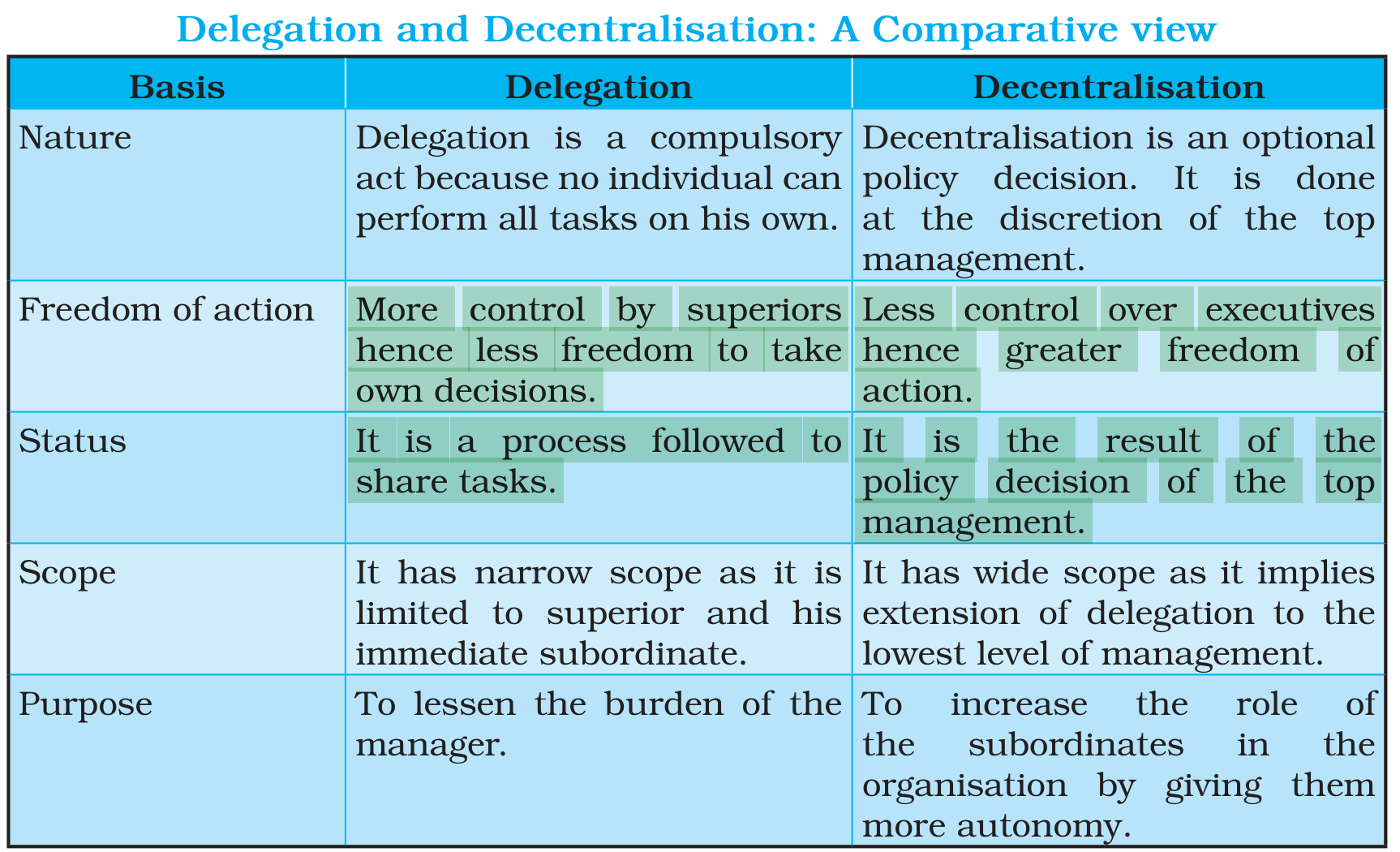
Which of the following is the correct distinction between delegation and decentralization?
(A) Delegation is a result of the policy decision of top management, whereas decentralization is a process.
(B) Delegation is a process, whereas decentralization results from the policy decisions of top management.
(C) Delegation is an optional decision and decentralization is compulsory.
(D) In delegation, there is more control by the superior, whereas in decentralization, there is less control over executives.
Choose the correct answer from the options given below:
Answer & explanation
Correct answer: option 2
The correct answer is Option (2) → (B) and (D) only
(A) Delegation is a result of the policy decision of top management, whereas decentralization is a process. — Incorrect. The feature is reversed for the two. Delegation is the process of sharing work. Decentralisation is the result of a policy decision of top management.
(B) Delegation is a process, whereas decentralization results from the policy decisions of top management. — Correct. A manager delegates to share his tasks with a subordinate. Decentralisation happens only when top management decides to spread authority to all levels.
(C) Delegation is an optional decision and decentralization is compulsory. — Incorrect. The feature is reversed for the two. Delegation is compulsory, because no one can do all the work alone. Decentralisation is optional; top management may or may not choose it.
(D) In delegation, there is more control by the superior, whereas in decentralization, there is less control over executives. — Correct. In delegation the superior keeps close control, so the subordinate has less freedom. In decentralisation executives at lower levels get more freedom of action.
NCERT (2026-27 Edition):
|